
What can an art print seller post on Instagram beyond the print itself?
Framing demos, room mockups, process clips and artist notes give print buyers context and scale, and none of it requires claiming editions or archival quality you cannot prove.
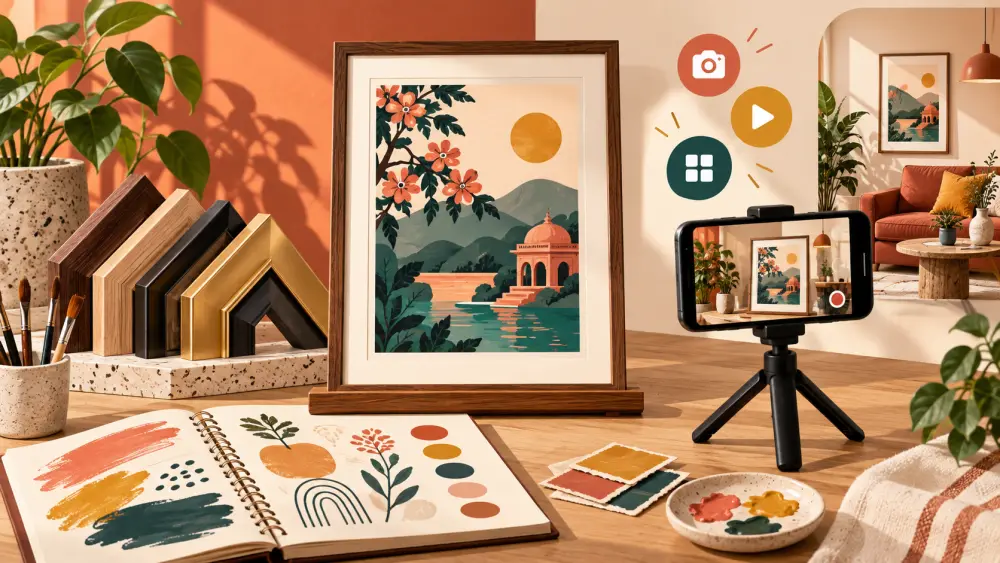
An art print on its own is a flat rectangle, and a feed of flat rectangles blurs together. What helps a buyer decide is context. How big is it? What does it look like on a wall? Who made it and why? Here are post ideas that put the print in a world, and keep your claims honest.
Room and wall mockups
Show your print on an actual wall, above a sofa, beside a window or on a shelf. If you do not have a styled room, borrow a corner of your home or a friend's. A real photo with a real frame is better than a heavily edited mockup because buyers trust it. If you use digital mockups, say so. Show different sizes against furniture, so people understand scale.
Size comparisons
Hold a print against a door frame, or beside a laptop, or against your own body. Put the dimensions in the caption in inches or centimetres. Many returns and disappointments come from guessing size. See how to photograph art prints and paintings flat for clean product shots.
Framing demos
Film a simple framing process, such as sliding a print into a frame, using a mount or hanging it with tape or hooks. Say whether the frame is included in the price. Show how the print arrives, flat or rolled, and how to handle it. If you sell unframed prints, suggest frame sizes that fit, but only if you have checked.
Process clips
Show how the art is made. A sketch turning into a finished piece, a painting before it is scanned, or a print coming out of a printer. Describe your tools and paper honestly. If a print is digital, say it is a print of the artwork.
Artist notes
Write a few lines about what inspired a piece, what you were thinking about and why you chose those colours. People buy art because it means something. Your own voice matters more than polished language.
Paper and print quality close-ups
Show the paper texture and edges in daylight and say what paper you use, with its name and weight if you know them. Describe what you can see and feel. Do not call prints archival, museum quality, fade-proof or limited edition unless that is actually true and you can explain what it means. If they are open editions, say so, or say nothing.
Colour accuracy
Prints can look different on screen and on paper. Show your print next to the screen or beside real objects in daylight, and say that colours vary a little. Describing colour accurately online explains how to do this.
Packing
Show how you pack prints flat with cardboard or in a rigid tube, and how you protect corners. People worry about creases, so show your care. For handling advice, see packing school supplies for courier safely for a similar flat-goods approach.
Series and collections
Group your work into small collections, such as botanicals, city sketches or festival themes, and introduce each in a short post. This helps visitors browse and gives you reasons to post again. How to organise products into collections and categories helps on the store side.
Keep claims clean
Do not promise that any post format will boost reach or sales. Share what is true about your work and let the pictures do their job. Connect interest to orders by linking your store in your bio, as in from Instagram bio to your first order.