
How to pack school supplies so they reach the customer safely
Practical packing steps for stationery and school set sellers, focused on bundles that stay together and arrive complete.
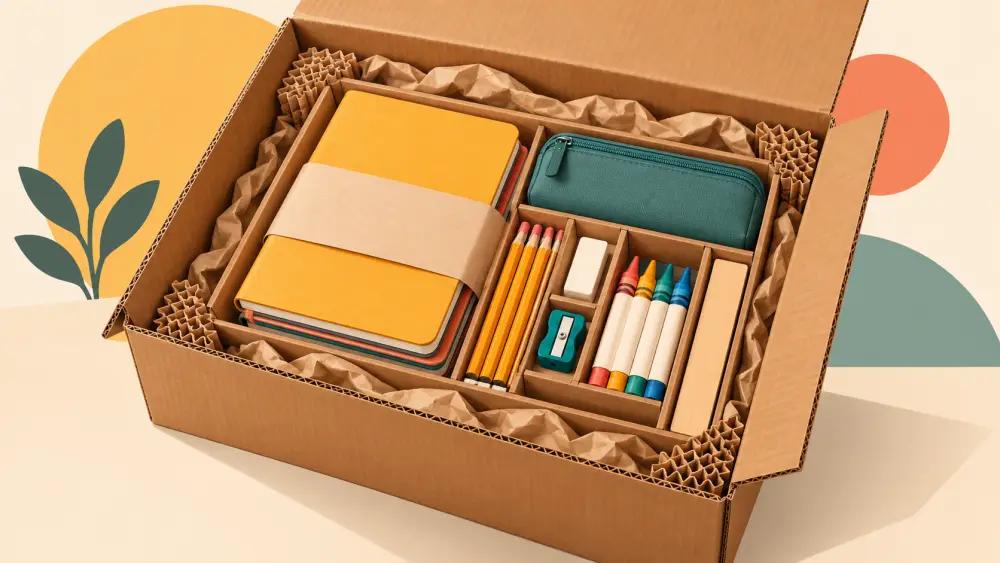
School supply parcels are full of small things: pens, erasers, sharpeners, scales, stickers, notebooks. Each item is cheap, but the set is only worth anything when it arrives complete and unbent. The most common packing failure is not breakage but loss: a missing eraser, a crushed notebook corner, a leaking pen. Packing here is mostly about keeping the bundle together.
Build the set on a packing table
Lay out the exact items in the order. Check them against the order list before anything is wrapped. A quick tick on a checklist at this stage prevents most missing-item complaints. If you sell sets, make a fixed list so each packer follows the same sequence.
Bundle small items together
Loose items drift in a carton. Group them:
- Put pens, pencils and erasers in a pouch or small box that closes firmly.
- Tie long items such as rulers and pencils together with a rubber band or paper band.
- Slide sets into a zip pouch or cloth bag, and add that bag to the main box.
- Place a printed packing slip listing every item inside the top of the box.
If the set is itself a product, such as a pencil box with contents, close it with a strip of tape that is easy to peel off so the customer can still use the box.
Protect paper goods
Notebooks and workbooks suffer from bent corners and rain. Stack them flat with cardboard on both sides, then wrap the stack in a plastic sleeve or a paper wrap. Do not place heavy items on top. For bulkier orders, use a rigid carton instead of a soft mailer. Corner protectors can be made from folded card. A sealed plastic bag on the outer layer protects against rain.
Handle liquids and fragile parts
Pens, ink bottles, glue and paint need extra care. Cap each pen firmly, store them tip up if the design allows, and put ink or glue in a sealed bag in case of leaks. Geometry instruments with pointed tips, such as compasses and dividers, should have their tips covered and be wrapped in cardboard. Glass or fragile items must have their own padding.
Use the right outer packaging
For a few notebooks and a pouch, a stiff poly mailer with a cardboard insert may do. For heavier orders, a corrugated box with some paper filler stops movement. Close the box and shake it softly: if the contents move, fill the gaps. Tape every seam. Add a shipping label and a duplicate on the inside of the box, in case the outer label tears.
Include a short note
Put in a card thanking the customer, stating how to contact you if something is missing, and noting how long they have to do so. Customers appreciate a clear route. If an item is missing, offer to send it or refund the difference; our post on issuing a partial refund for missing items explains how.
Record each parcel
Take a quick photo of the packed contents before closing the box, with the packing slip visible. If the customer says something is missing, the photo shows what you shipped. Combined with clear records, this keeps disputes civil.
Think about shipping
Weight matters for many sellers; weigh the packed parcel and note it so you can check courier charges. Our guide to shipping across India discusses what to keep in mind. For product basics and pricing of stationery in general, how to start selling stationery online is a good companion.
Pre-dispatch checklist
- Items counted against the order.
- Small items pouched together.
- Notebooks flat and protected.
- Liquids bagged.
- Sharp tips covered.
- Packing slip and note inside.
- Photo taken.
Complete, tidy bundles earn repeat orders from parents who buy every year.