
What is a size chart? (and why it cuts returns)
A size chart lists the real garment measurements in inches for each size so a buyer can compare against a piece they already own and pick the right fit.
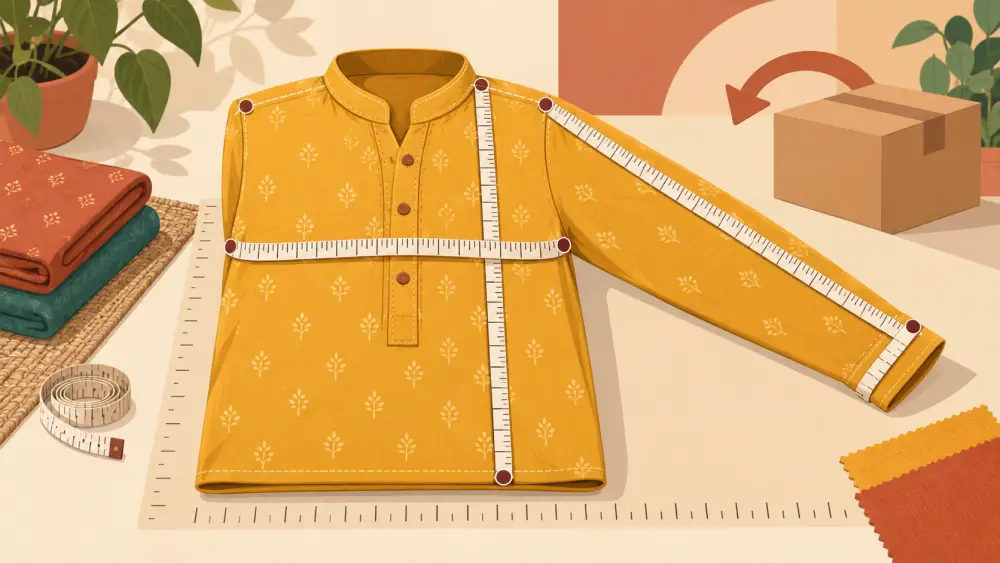
What a size chart is
A size chart is a small table or image that shows what each size actually measures. Instead of leaving the customer to guess what "M" means at your brand, it gives them numbers in inches they can check against a garment from their own wardrobe.
Sizes are not the same across brands, and many small Indian brands cut their own patterns. The label alone is not enough.
What goes in it
For a kurti, you might list these for each size.
- Bust or chest, measured around the garment at the fullest part.
- Waist.
- Hip.
- Shoulder width.
- Length, from the shoulder to the hem.
- Sleeve length, if relevant.
An illustration: size M kurti measures bust 38 inches, waist 36, hip 40, shoulder 14, length 44. Size L measures bust 40, waist 38, hip 42, shoulder 14.5, length 44. The numbers are only an example, so use your own.
State clearly whether these are garment measurements or body measurements. Garment measurements tell you the size of the finished piece, which already includes room to move. Body measurements describe the person it is meant to fit. Our post on body measurements versus garment measurements explained clears up the difference, and it matters, because mixing them causes the exact mistake a size chart is meant to prevent.
How to measure the garment
- Lay the piece flat on a table, smooth out wrinkles, and fasten buttons or zips.
- Use a soft tape in inches.
- For bust, measure straight across from underarm to underarm and double it, unless the fabric is very stretchy.
- Repeat for waist and hip the same way.
- Measure length along the back, from the highest point of the shoulder to the hem.
- Write down every number and measure a second time.
Our full walkthrough is in how to measure a garment for a size chart. Stretchy fabrics can vary a little, so mention that in a line near the chart.
Why it helps with returns
Many returns in clothing happen because the item did not fit. A clear chart lets customers choose with more confidence, so fewer parcels come back for the wrong size. I will not put a figure on how much, because it depends on your products and customers. But the reasoning is simple: the more a buyer knows before ordering, the fewer surprises on delivery.
Make it easy to use
- Put the chart on the product page, not buried on a different page.
- Add one line on how to use it: "Measure a kurti you like and compare."
- Show the model's height and the size she is wearing.
- If you sell free size, say so, and give the measurements. See how to handle sizes when you sell free size.
You can also photograph the chart as an image so it is readable on a phone. Read how to photograph and show a size chart image and making a size chart for your clothing store.
Finally, keep the numbers honest. If a batch comes out half an inch smaller than the chart, update it. A chart you can trust is worth more than one that looks tidy.