
Returns and complaints when selling terracotta pieces online and how to reduce them
Breakage claims are the main terracotta dispute. Here is how to set expectations in the listing and gather proof so fewer complaints turn into losses.
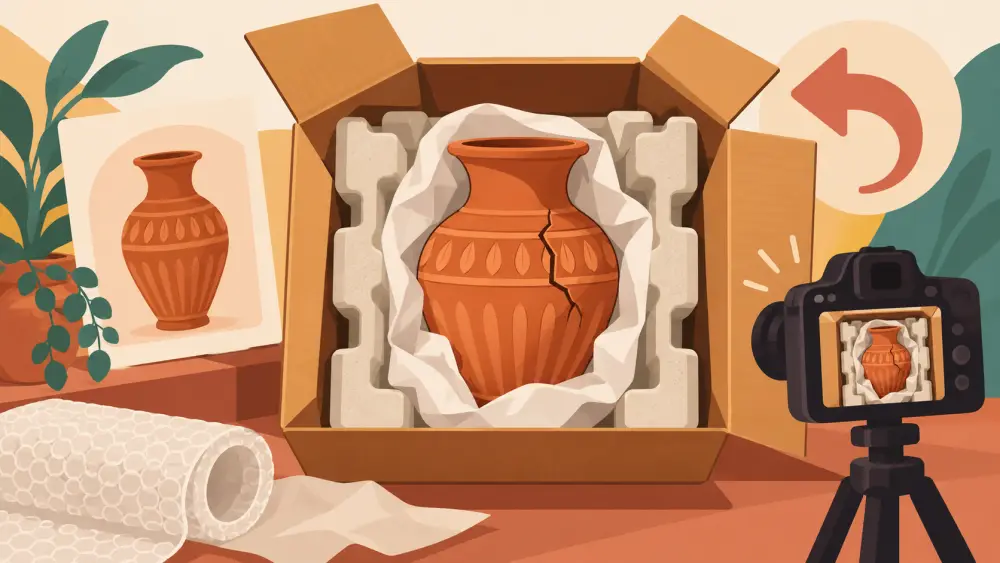
Clay breaks. That is not a flaw in your product, it is the nature of the material, but the customer who opens a cracked pot does not feel philosophical about it. For terracotta sellers, almost every serious complaint is a breakage claim, with a few about size and colour. You cannot remove the risk, but you can shrink it and make each dispute easier to settle.
Understand the three kinds of breakage claim
First, the piece really was damaged in transit. Second, the piece had a hairline crack before it left you. Third, the piece arrived fine and cracked later, for instance after being filled with water or left in frost or hot sun. Each has a different cause and a different fix, and only the first two are within your control.
Reduce transit damage
Most real breakage comes down to packing. Wrap each piece alone, support the inside of planters, separate pieces with dividers and use a box with cushioning on every side. Our post on packing terracotta gives the steps. A well-packed parcel is the cheapest return policy you can have.
Inspect before dispatch
Tap every piece and look at rims and handles in good light. Do not send anything you have doubts about. Keep a small record, even a photo of each piece before wrapping, so you can compare it with what the customer shows later.
Describe the product honestly
Tell buyers what the material is and what it can and cannot do.
- State the dimensions in centimetres and the weight if useful.
- Say whether the piece is glazed, painted or raw clay, and whether it has a drainage hole.
- Mention that terracotta is porous and handmade, so small variations in colour and surface are normal.
- Give basic care: avoid sudden temperature changes, do not drop it, and keep it off hard floors in transit.
Describing material honestly and care instructions give wording ideas. Do not make claims about strength or durability that you cannot back up.
Set expectations on size and colour
Many "not as shown" complaints are about scale. Show a hand or ruler in the photos, and give dimensions. See photographing terracotta. For colour, explain that clay varies between batches and show real examples.
Ask for proof in your policy
Write a short, visible policy that says:
- If a piece arrives broken, message you the same day or within a stated time.
- Send photos of the damaged piece, the packaging and the shipping label.
- Keep the box until the claim is resolved.
- You will offer a replacement or refund after reviewing the photos.
This is not about being suspicious. It simply gives both sides what they need to decide fairly. Avoid copying legal wording; if you need to know what the law expects of you, ask a professional.
Resolve quickly and decide your rule
Decide in advance what you do in each case: full refund, replacement or partial refund for a minor chip. A chipped rim on a decorative pot might deserve a small refund rather than a return shipment. Our partial refund guide shows how to do this, and cancellations, refunds and restocking covers the full flow.
Check your numbers
Breakage is costly: you lose the piece, the shipping and the sale. Keep a log of each claim, the product and the cause. If one piece type breaks more than others, change its packing or its design, or stop shipping it far. Returns and RTO describes how returns eat into a small brand's margin.
Checklist
- Pieces inspected and photographed.
- Packing tested.
- Dimensions and care in the listing.
- Natural variation explained.
- Policy and proof requirements visible.
Honest listing, careful packing and a clear claim process will keep terracotta complaints small and fair.