
How many variants is too many for one product listing?
There is no magic number, but too many colour and size options can confuse customers and make stock hard to track. Here is how to judge your own limit.
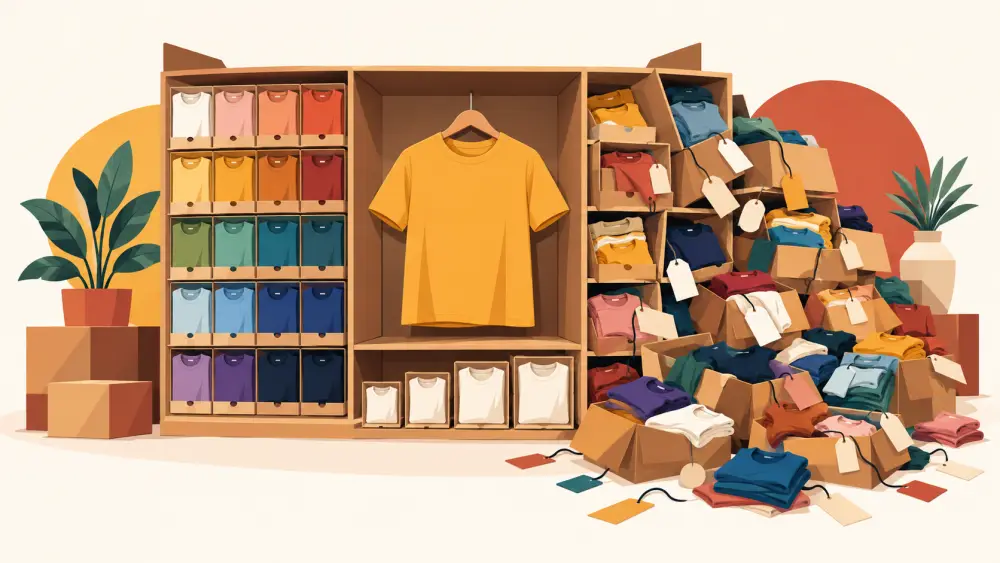
Nobody can give you an honest fixed number for this, and anyone who does is guessing. What we can do is look at what goes wrong when there are too many options, and use that to decide for your own products.
What too many looks like for the customer
A shopper opens your product and sees twelve colours and five sizes. Before they can decide, they have to take in sixty combinations. Some will be unavailable. The decision gets heavier, not lighter. If you notice customers messaging to ask "which one do you recommend", that is a sign the options are overwhelming.
What too many looks like for you
Every variant is something you have to keep in stock, photograph and count. If you carry a handful of pieces in each of dozens of combinations, you will constantly have a few sold out and a few gathering dust. Many small stores are easier to run with fewer, well stocked options. See the case for a smaller catalogue.
Questions to find your own limit
- Can I afford to stock each combination, even in a small quantity?
- Can I photograph each colour properly? A swatch with no real photo is a weak option.
- Does each option sell, or do some sit untouched?
- Can I tell at a glance what is in stock?
If you answer no to several, trim.
Practical ways to reduce
- Remove the slowest sellers from the list rather than keeping everything.
- Merge near-identical shades. If sand and beige look almost the same, keep one.
- Limit sizes to those you can actually make or source.
- Offer fewer colours per release and rotate them, like a Drop.
How the Varchas editor treats it
On a Varchas store, a product can carry several colourways, each with its own price, stock and S, M, L and XL counts, and the editor shows a total stock figure and a price range across them. It also flags colours with low or zero stock, so a long list is visible at a glance. Seeing those numbers is a useful way to notice which options deserve to stay. The structure is explained in setting up product variants properly.
Use one product for choices, many for different things
If your list of options keeps growing because the items are really different designs, the answer may be separate products rather than more variants. See when something should be a variant and when a separate product.
Make each option easy to name
When there are many options, clarity of names matters more. A shopper should know immediately what "Rust" or "Sand" refers to; how to name colour and size options clearly covers this.
A sensible way to start
Start with fewer variants than you think you need. Add a new colour or size only when customers ask for it more than once. That keeps your stock honest and your product page easy to read. You can always add more, and it is harder to take away an option customers have already got used to.