
When should something be a variant and when a separate product?
A practical decision rule for choosing between a variant and a separate product, based on price, photos, description and how customers shop.
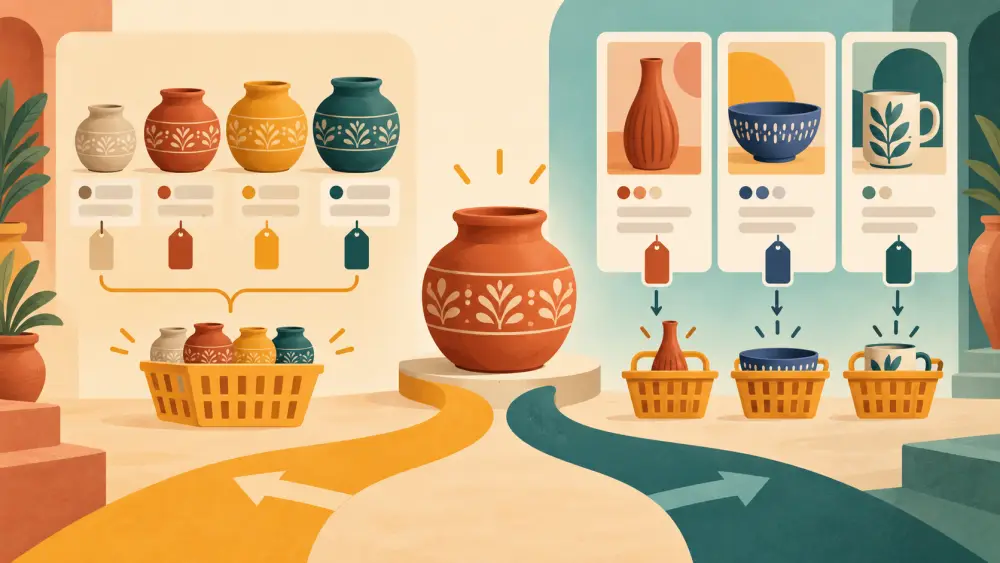
You sell a tote bag in three colours. Is that one product with three options, or three products? You sell a candle in two sizes. Same question. The answer affects how your catalogue looks, how stock is counted and how easy it is for a customer to choose. Here is a rule that works for most small stores.
The core idea
A variant is the same product in a slightly different form. A separate product is something a customer would think of as a different thing. If you can say "it is the same item, just in another colour or size", it is probably a variant.
Four questions to ask
- Is the price roughly the same, or at least predictable? Different sizes or colours that differ slightly in price still fit as variants. A big gap in price or purpose suggests separate products.
- Is the description the same? If the fabric, care, story and key facts are the same apart from colour or size, keep it as one product. If each version needs its own explanation, split them.
- Do the photos tell the same story? A tote in three colours can share a layout of photos. A candle in a jar and a candle in a tin with different looks may deserve separate pages.
- Would a customer compare them side by side? If the buyer is choosing between colours, show them together. If they would never confuse them, keep them apart.
Examples
Likely variants:
- A kurta in olive, sand and black, sizes S to XL
- A tote bag in tan and black
- A hair oil in 100 ml and 200 ml, if the description is the same
Likely separate products:
- A kurta and a matching dupatta
- A plain candle and a festive hamper containing candles
- Two designs that share a fabric but have different prints and stories
How colourways work on a Varchas store
In the Varchas product editor, a product can have colourways. Each colourway has a name, a swatch colour, its own price and stock, its own main image and optional extra photos, and stock counts for S, M, L and XL. If you add no colourways, the product simply sells on its own price and stock. When colourways exist, the product's displayed price and total stock are derived from them. You can read more in setting up product variants properly.
This means colour and size choices fit naturally into one product page, and you do not have to create a new listing for each shade.
When splitting helps
Splitting makes sense when different versions need their own photos, price and description, or when you want to run a limited Drop for just one design. It also makes sense when the choice is not really about colour or size but about a different design.
When merging helps
Merging makes sense when you have several near-identical listings that confuse buyers or split your reviews and stock counts. A smaller, tidier catalogue is easier to manage, which is the idea behind the case for a smaller catalogue.
Check your title
If you decide on variants, keep colour and size out of the title; see should product titles include colour and size.
If you are unsure
Pick one, publish and watch the questions customers ask. If they keep asking which version is which, restructure. Changing your mind later is normal.