
What is batch production? (and when does it suit small brands)
Batch production means making a set quantity in one run instead of one piece at a time, and the real work is choosing a batch size you can sell before it goes stale.
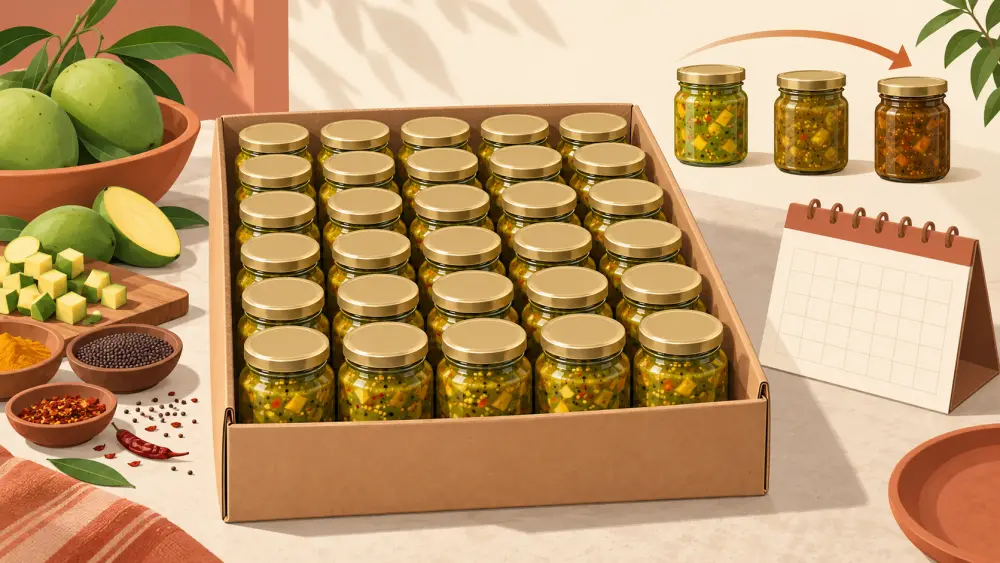
Batch production is making a fixed quantity of a product in a single run. Instead of preparing one jar when an order arrives, you prepare 30 jars at once, store them, and sell from that stock. It is the opposite of making every piece after an order, which is made-to-order.
A pickle batch, in numbers
Say you make mango pickle. One batch gives you 30 jars. In a day you can cook, mix and fill the whole lot. Doing it as 30 separate single-jar efforts over a month would use far more of your time.
Some things get easier in a batch:
- You buy ingredients and jars for 30 at once.
- Cooking and cleaning happen once.
- Labelling and packing can be done in an assembly line.
Some things get harder:
- You must be able to sell 30 jars.
- You must store them properly until you do.
- If the batch has a problem, all 30 have it.
Shelf life shapes the batch size
For anything that ages, the batch must fit what you can sell in its useful life. This is where many small brands go wrong. Suppose a jar stays good for a certain number of weeks, according to your own tests and the advice you have taken. If you usually sell 10 jars a week, a 30-jar batch needs about three weeks to clear. If your sell-by window is shorter than that, the batch is too big, and the last jars are the ones you will struggle with.
A simple method:
- Estimate weekly sales honestly, from your own orders.
- Find the useful life of the product.
- Choose a batch that sells out comfortably within that life.
- Mark the batch date on every jar, so you sell oldest first.
I will not make any food safety or licensing claims. Rules about food products vary, so check with the relevant authorities and professionals about what applies to you. For the selling side, see how to start selling pickles online in India.
What a batch does to your costs
Each batch has fixed effort, such as fuel, setup and cleaning, shared across all the jars. Make more per batch and each jar carries less of that effort, up to the point where waste appears. Batch production cost per unit shows how to calculate it. Include wastage too, as in raw material wastage in costing.
When it suits small brands
- Your demand is steady and predictable.
- The product keeps well, or you have a clear way to sell it quickly.
- The product does not need customisation.
- Your time is the scarce resource, and you want to use it in concentrated blocks.
When to be careful
If demand is unpredictable or the product is custom, big batches turn into dead stock. Start with a small batch, watch what sells, and grow the next one.
Your store and batches
The Varchas admin tracks stock per product, with sizes and colourways handled as variants, so after each batch you update your count. I did not find a batch or expiry field in the code, so keep batch dates in your own notes. How to count inventory in a small business is a good companion.
Next step
For your best-selling product, write the weekly sales, the useful life and a batch size that fits both.