
How do I find the cost per unit when I make products in batches?
Add every cost of one batch, including fuel, packaging and your time, then divide by the number of units that came out good.
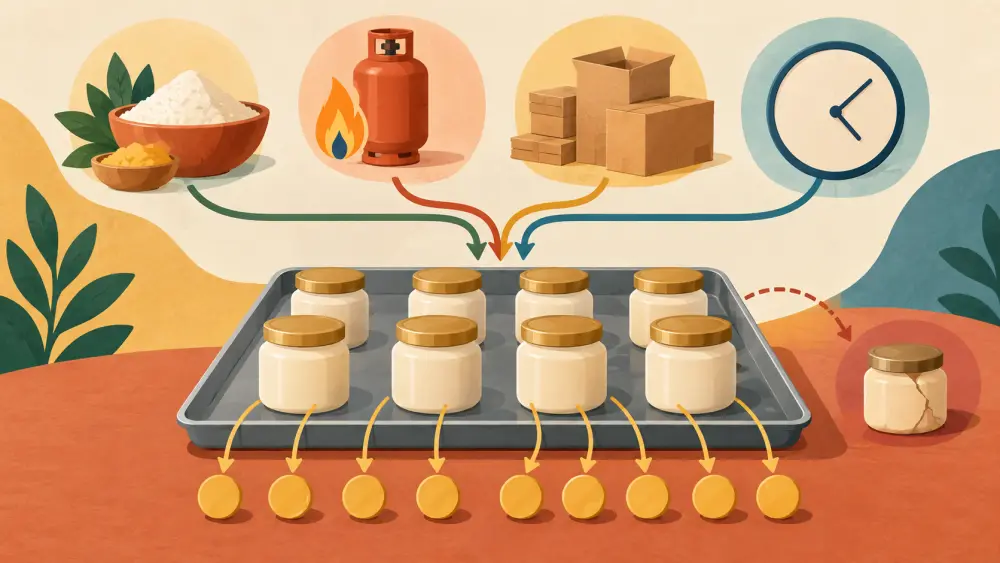
If you make candles, soaps, snacks, pickles or similar things in batches, you cannot read the cost of one unit off a bill. The costs arrive as a pile, ingredients here, gas there, packaging somewhere else. The trick is to cost the whole batch first and then divide.
List every cost of one batch
Take a batch that makes 40 units. Write down everything that went into it.
- Ingredients or raw materials: Rs 1,200.
- Fuel or electricity used: Rs 100.
- Packaging for 40 units: Rs 400.
- Labour: 2 hours of work, valued at Rs 100 an hour, which is Rs 200.
Add them up: Rs 1,200 plus Rs 100 plus Rs 400 plus Rs 200 is Rs 1,900.
Divide by the units
Rs 1,900 divided by 40 units is Rs 47.50 per unit.
That is the cost of making one unit. It is the number to use when you price, not just the ingredients alone, which would have given Rs 30 a unit and made your product look much more profitable than it is.
Do not forget the failures
If 2 of the 40 units come out badly and cannot be sold, you have only 38 good units. Divide by 38: Rs 1,900 divided by 38 is Rs 50. Failures push the cost up. Count only the units you can sell, and let the cost of the rest be carried by the good ones.
Things people leave out
- Your own time. Even if you pay yourself nothing today, include a rate. See how to put a price on your own time.
- Cleaning, setup and cooling time. The two hours of labour should cover all of it, not just the minutes you stir.
- Small ingredients. A pinch of this and a few drops of that add up across a batch.
- Testing and samples. If you routinely give away or test a few units, they are part of the batch cost.
- Shipping and the share of monthly overheads. These come after production cost. They are covered in overhead per order and landed cost per unit explained.
Use a batch sheet
Keep one simple sheet, a page in a notebook or a spreadsheet, for each product. Each row is a cost. Each time you make a batch, update the amounts, because ingredient prices change. At the bottom, put total cost, good units and cost per unit.
When the cost per unit moves by more than a rupee or two, look at your price.
Scaling a batch
Larger batches often bring a lower cost per unit, because fuel, setup time and packaging overheads are spread over more units. But there is a limit: a batch too large for your equipment or shelf life creates waste. Try the maths for a batch of 80 units with the same ingredients doubled, and see how fuel and labour behave. If labour only goes from 2 to 3 hours, your unit cost drops.
From cost to price
Once you know Rs 47.50, use price from a target margin to set your selling price. If your products involve materials lost in making, read wastage in costing. For a full handmade example, see the cost price of a handmade product.
Do one batch sheet this week, and you will price with far more confidence.