
How do I include wastage in my cost per unit?
When part of your raw material is cut away or spoiled, divide the total spend by the usable amount, not the amount you bought.
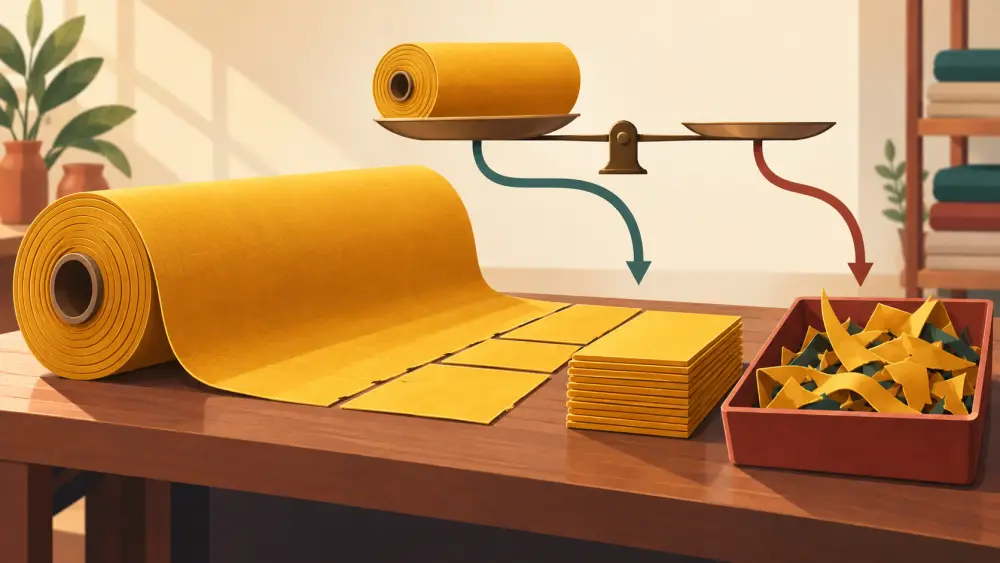
If you make products from fabric, leather, wood, paper or anything you cut and shape, you never use every last bit. Offcuts, mistakes, frayed edges and leftovers are real costs. The mistake many sellers make is to cost their product from the price they paid per metre, not the price per usable metre.
The simple correction
Cost per usable unit = total money spent divided by usable quantity.
Take fabric. You buy 10 metres at Rs 200 a metre, so you spend Rs 2,000. When you cut and stitch, 1 metre ends up as waste, whether from bad cuts, flaws in the cloth or offcuts too small to use.
Usable fabric is 9 metres. Rs 2,000 divided by 9 is Rs 222.22 per usable metre.
So the fabric that actually goes into your products costs Rs 222.22 a metre, not Rs 200. That is an 11 percent higher cost than the one on your supplier bill (Rs 22.22 more than Rs 200).
Why this matters for your price
Say each product uses 1.5 metres. At Rs 200 a metre you would put Rs 300 in your costing. At Rs 222.22 a metre the true figure is about Rs 333.33.
That is Rs 33.33 per piece you would otherwise miss. On 100 pieces, it is more than Rs 3,300 of profit that never appears. A product you priced for a 40 percent margin may really sit at 35 percent.
Wastage is not the same as a mistake
Plan for normal wastage, the unavoidable offcuts in your process. If you ruin half a metre through carelessness, that is a loss to fix in your process, not a cost to pass on to customers. Keep these separate in your notes so that you do not inflate your prices to cover avoidable errors.
How to find your wastage rate
Do not guess. Measure on a few real production runs.
- Weigh or measure the material you start with.
- Make the batch.
- Measure the leftover and the spoiled pieces.
- Divide waste by the starting quantity. In the example, 1 metre out of 10 is 10 percent.
Repeat for a couple of batches and use the average. Different products have different wastage. A pattern with large pieces wastes less than one with many curves.
Reducing wastage
- Plan your cutting layout on paper before you start.
- Use offcuts for small items such as pouches, scrunchies or labels, giving the waste a second life. Cost that small item with the offcut at a low value, not at the full rate.
- Inspect material when it arrives, and raise flaws with the supplier straight away.
- Buy in sizes that match your patterns, so you do not end up with awkward remainders.
Put it into your full costing
Wastage is one line in a larger cost sheet. Add materials with wastage, labour, packing, shipping and overhead share. The post on the cost price of a handmade product shows the full structure, and landed cost per unit explained covers transport and other charges on what you buy.
Once you have a clean cost, price from a target margin so the wastage you counted is paid for by the customer who buys the finished piece, not by you.