
Packing ceramics and pottery so they arrive in one piece
Wrap every ceramic piece separately, nest it in a snug box with cushioning on all sides and keep pieces apart, which reduces the chance of chips and cracks in transit.
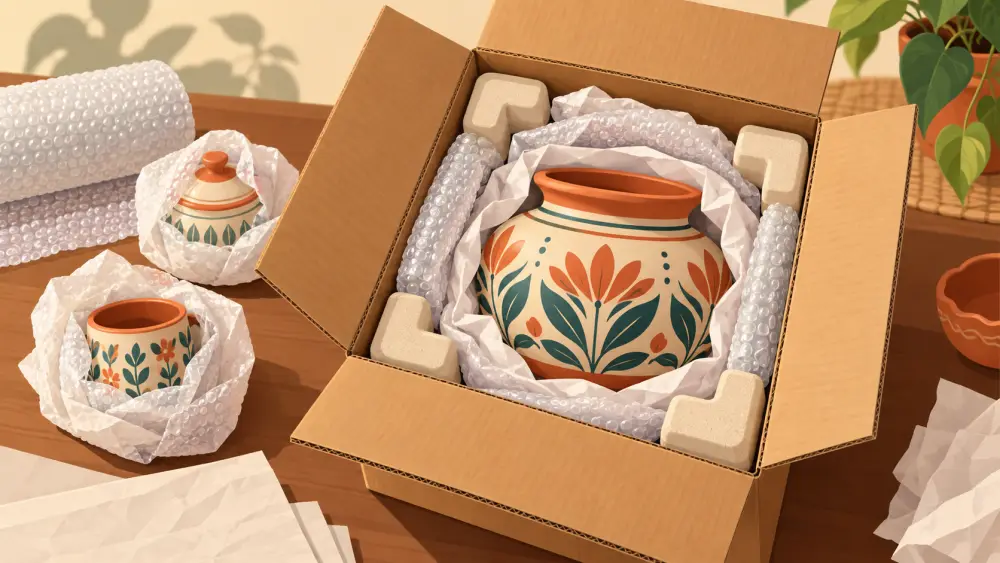
Ceramic cups, plates, planters and decorative pieces are loved by buyers and feared by sellers. The glaze looks tough but edges chip easily, handles snap and thin rims crack. Packing them is mostly patience: every piece gets its own protection, and the box is snug, not roomy.
Know the weak points
Walk around the piece and note where it is most likely to break.
- Handles and spouts, which stick out and take leverage on impact.
- Rims and lips, which are thin.
- Lids, which can slide off or knock against the body.
- Feet and bases, which carry weight if something is stacked on top.
These are the areas to wrap most carefully.
Wrap each piece separately
Never put two ceramic pieces in the same wrap. Even soft contact can chip a glaze over a journey.
- Cover the piece with a first layer of soft tissue or paper so bubble wrap does not leave a mark on the glaze.
- Add two or three turns of bubble wrap, with extra at the handle, rim and base.
- Wrap lids on their own, and place them back on the item only if they sit firmly and cannot rub. Otherwise, pack them in a separate wrap beside the piece.
- Tape the wrap down so it stays put.
For cups and mugs, stuff the inside with crumpled paper before wrapping the outside so the walls are supported from both sides.
Choose a snug box
Pick a box with room for about a few centimetres of cushioning all around the wrapped piece. Too large, and the item moves. Too tight, and there is no room to absorb a knock.
- Put a layer of crumpled paper or foam at the bottom.
- Place the wrapped piece in the centre.
- Fill the sides and the top until it holds firmly in place.
- Close the box and shake it gently. You should not feel anything move.
Sets and multiple pieces
If you are sending a set, place each wrapped piece in its own compartment. A cardboard divider between pieces prevents contact. Do not stack plates or bowls on top of each other without a cushion in between, and keep heavy pieces at the bottom.
For larger or valuable pieces, it is often safer to use a box within a box. The inner box holds the item and cushioning, and the outer box has additional space filled with padding. The two layers absorb more of a hit than one thick layer.
What you cannot promise
Pottery may be handled roughly and nobody can guarantee a parcel will arrive without a chip. Be honest in your listing and in your messages. Say how you pack, and say what you will do if something arrives damaged. Decide your policy before the first complaint, and ask for a photo of the damage. issuing-a-partial-refund-for-missing-items may be useful for deciding partial refunds, and cost-of-a-damaged-in-transit-parcel shows what each loss costs.
Keep a quick record
Photograph each packed parcel before you close it. If a claim comes up, you have proof of how it was packed. And keep a note of which products get damaged most, then improve their packing.
For an overview of the layered method, read how-to-pack-fragile-items-for-courier. For a closely related clay craft, there is also packing-terracotta-for-courier-safely, which covers the more porous kind of pottery.