
How to pack fragile items so they survive courier handling
Wrap each item, cushion it on every side, use a rigid outer box and leave no empty space inside, then label the parcel clearly, which lowers the risk of damage in transit.
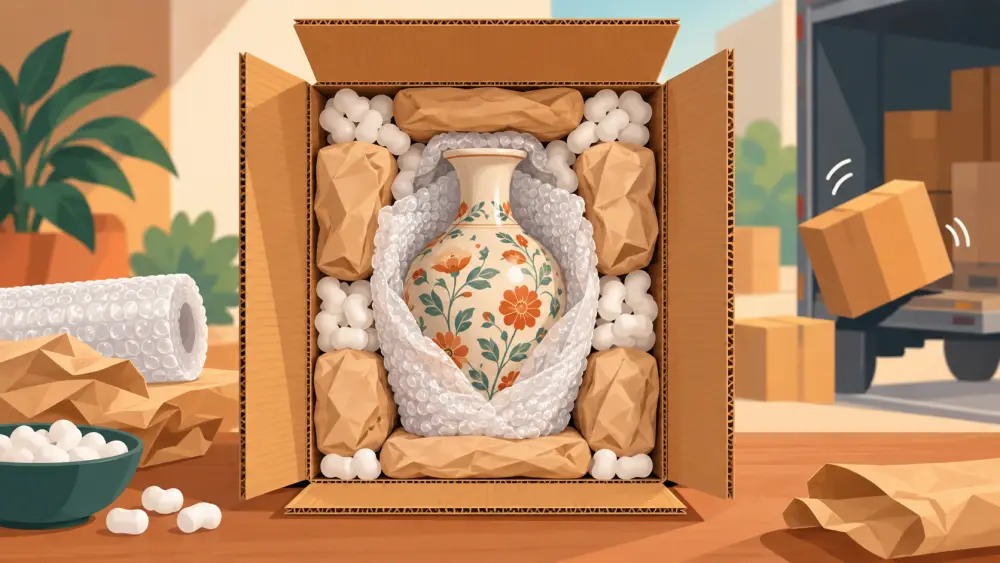
Courier parcels get dropped, stacked, tilted and squeezed between other parcels. You cannot control that, and no packing method makes a fragile item safe from every knock. What you can do is give the item the best chance, and the way to think about it is in layers.
Think in layers
A well packed fragile parcel has four layers working together, from the item outward.
- Wrap. Cover the item itself so surfaces do not rub or chip against each other.
- Cushion. Add soft material around the wrapped item so shocks are absorbed.
- Box. Put it in a rigid box that does not crush easily.
- Fill. Remove empty space so the item cannot slide or rattle.
If any one layer is missing, the others have to work harder. A thick box with a loose item inside lets the item bang around. A soft mailer with a glass piece gives no protection against a corner hit.
Step by step
- Wrap the item in a soft layer such as tissue or bubble wrap. Cover handles, spouts, corners and edges, because these parts break first.
- Add a thicker cushion around it. Bubble wrap, crumpled paper or foam all work. Aim for a few fingers of space between the item and every wall of the box.
- Choose a box that is a little larger than the item with its cushioning, not much larger. A very big box invites movement and gets crushed more easily.
- Use a sturdy corrugated box. If it bends when you press the sides, it is too weak for fragile goods.
- Put a layer of cushioning at the bottom, place the item in the centre, then fill the sides and top.
- Close the lid and give the box a gentle shake. If you hear or feel movement, add more filling.
- Tape every seam with strong tape, and tape the edges of the flaps as well as the centre.
No empty space
Empty space is what turns a fall into a break. When the item can slide a few centimetres, it picks up speed and hits the wall. Fill the gaps with crumpled paper, air pillows or folded cardboard. The goal is that the item stays where you put it even if the box is turned over.
Multiple items in one parcel
If you send two fragile things together, wrap them separately and keep a layer of cushion between them. Items touching each other can chip or crack on impact, even if both are well wrapped from the outside.
Mark the parcel, but do not rely on it
A "fragile" or "this side up" label is worth adding. It may help the person who carries the parcel. But treat it as a request and not a guarantee. Pack as though the label will be ignored.
Check your own results
Keep a simple note of every damaged parcel, what was inside and how you packed it. After a few notes you will see patterns, perhaps one product that always breaks at a corner. Fix the packing for that product. cost-of-a-damaged-in-transit-parcel shows what each loss really costs you, which tells you how much extra packing is worth spending.
Packing cost is part of your price
Good packing costs money, but a broken parcel costs more, since you lose the item, the shipping and the customer's trust. See packaging-cost-per-order-breakdown to count it properly. For packing guidance on a specific type of product, try packing-terracotta-for-courier-safely or packing-resin-art-for-courier-safely.