
How many good orders does it take to pay for one return?
With Rs 250 profit per order and Rs 155 cost per return, one return erases 0.62 of an order in cost, and ten returns in a hundred orders take a noticeable slice of your month.
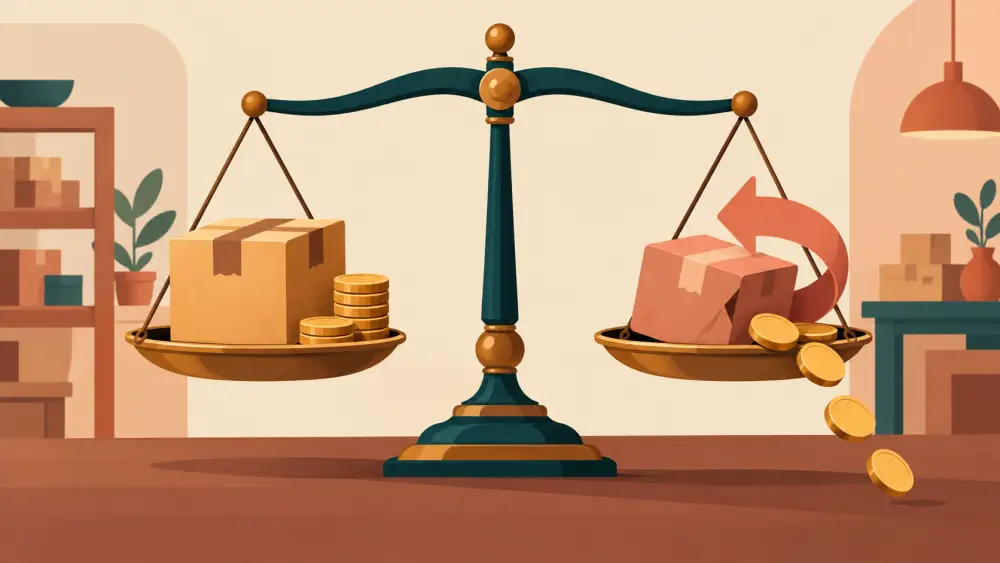
Returns can feel like a small part of a busy month. A few parcels come back, you refund, you move on. But it helps to translate each return into good orders, because that shows how much selling you have to do to recover from one.
The numbers
These are illustrative.
- Profit on a kept order: Rs 250
- Cost of one return, meaning shipping both ways, repacking and any lost stock: Rs 155
If you need to build the second number, see how to calculate the full cost of a customer return.
The first answer
155 divided by 250 = 0.62.
So the cost of a return equals the profit from 0.62 of a good order. In plain words, you need to sell and keep about two good orders to pay for three returns. Or, put the other way, every third return costs you the profit of two orders.
The harder truth
That answer counts only the cost of the return. It forgets the order itself, which did not happen. A returned order does not just cost you Rs 155, it also fails to earn its Rs 250.
Compare with the situation where the customer kept the product.
- Kept: you earn Rs 250
- Returned: you lose Rs 155
- Difference: 250 + 155 = Rs 405
Against a kept order, one return is worth Rs 405, or 405 divided by 250 = 1.62 orders. So each return wipes out the profit from one good order and more than half of another.
Ten returns in a hundred orders
Now see what this does to a month with 100 orders.
- All 100 kept: 100 x 250 = Rs 25,000
- 10 returned: 90 kept earn 90 x 250 = Rs 22,500, minus 10 x 155 = Rs 1,550, leaving Rs 20,950
That is Rs 4,050 less than the perfect month, which is exactly 10 x 405. A 10 percent return rate takes about 16 percent of your potential profit.
Why this changes how you act
Returns often feel like a customer service problem. In truth they are a profit problem, and the cure usually sits earlier in the process.
- Accurate photos and descriptions reduce returns caused by surprise. See describing colour accurately online and describing material and fabric honestly.
- Clear size information cuts out the most common reason for returns in apparel.
- Better packing prevents damage in transit.
- A good unboxing and care note can reduce returns that are really misunderstandings.
A target worth setting
Use your own numbers. Decide how many returns per hundred orders you can live with, then count how many good orders it takes to pay for them. If your profit per order is thin, even a few returns can consume the month's gain.
Put it on one line in your notebook. Each return costs about 1.6 orders of profit. Then, before you spend an hour fixing a product photo, you can compare it with the profit a handful fewer returns would give you. Returns and RTO, the numbers nobody tells you offers more context on the topic.