
How do I calculate the full cost of a customer return?
A return costs you shipping both ways, repacking and any stock you cannot resell, and all of that sits on top of the money you refund.
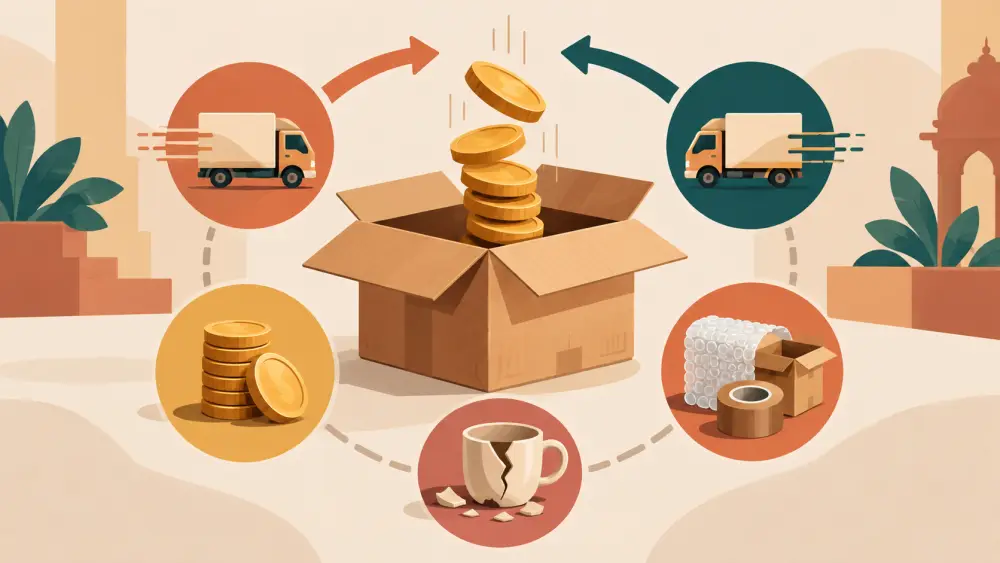
When a customer returns an order, most sellers think only about refunding the amount. But the refund is only one piece. A return has a full cost, and if you do not count it, you will underestimate how much returns hurt.
Step 1, list what you paid out
Take a real return and write down every rupee it cost you beyond the refund. Here is an illustrative example for an order of Rs 900.
- Shipping to the customer: Rs 70
- Shipping back to you: Rs 70
- Repacking so it can be sent again, with a fresh bag, tag and tape: Rs 15
- Stock that cannot be resold, for instance a stained or damaged piece, valued at cost: Rs 40
Step 2, add them up
70 + 70 + 15 + 40 = Rs 195.
That Rs 195 is gone, and it sits on top of the refund of Rs 900 that goes back to the customer. It is not the refund itself, since the refund simply returns money you collected, but it is a real loss.
Step 3, add the profit you did not make
If the sale had stayed, you would have earned a profit. Say Rs 250 on this order.
- Cost of the return: Rs 195
- Profit lost: Rs 250
- Total swing compared with a kept order: Rs 445
This second number is the honest comparison. A kept order puts Rs 250 in your pocket. A returned one costs you Rs 195. The difference is Rs 445.
Step 4, check for hidden items
Look at your own situation for costs that are easy to miss.
- Payment fee on the original payment, which may not be refunded to you. Check how your payment provider treats this.
- Time spent handling the return, including inspection and messages
- A discount code that was used and now cannot be reused
- Reviews and customer goodwill, which are harder to value
You do not need to put a rupee amount on all of these, but note them.
Step 5, find your average
One return is a story. Fifty returns are data. Take your last month of returns and divide the total of Step 2 costs by the number of returns. That is your average cost per return. Use this figure in your planning.
What to do with the number
- Use it to set a realistic return policy. If a return costs you Rs 195 and your profit on the item is only Rs 150, a free-return promise loses money on every return.
- Use it to decide when an exchange is better. Exchange versus refund cost comparison works through that case.
- Use it to see how returns affect monthly results, as in return rate impact on monthly profit.
- Share it with your supplier if returns come from a quality issue.
For the process side, read cancellations, refunds and restocking, and when you need to send money back, see processing a full refund via Cashfree.
A return is rarely a free event. Once you know its price in rupees, you can decide calmly how much effort to spend on stopping it.