
"What is volumetric weight? (and why parcels cost more than expected)"
Volumetric weight is a size-based weight that couriers may bill when your box is big and light, which is why a feather-light parcel can still cost more than you guessed.
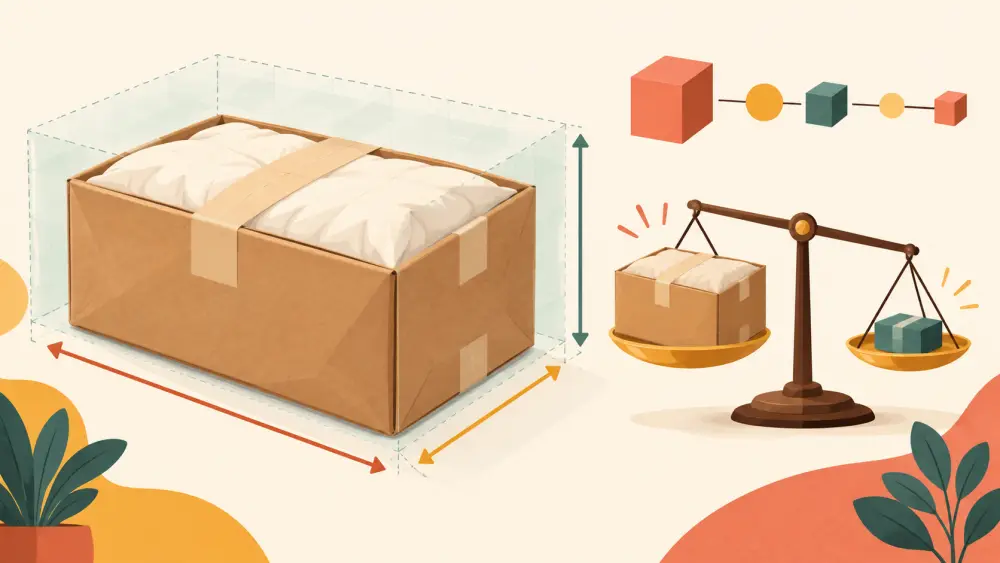
You weigh a parcel on your kitchen scale, it shows 600 grams, and you assume the shipping cost will match a 600 gram parcel. Then the charge comes out higher. Very often the reason is volumetric weight. It trips up almost every new seller once.
The idea in one line
A courier has only so much space on a vehicle or in a bag. A big box that weighs almost nothing uses up space that a dense parcel could have used. So many couriers compare two numbers for each parcel, the real weight and a weight worked out from the box size, and bill using the larger one.
The size-based number is usually found by multiplying length, width and height in centimetres and dividing by a fixed number. That fixed number is set by the courier, and it can differ between couriers, so always ask yours or read their terms. I am not going to quote any real figure here.
A worked example with an illustrative divisor
Say you sell a cushion pack in a box that measures 30 cm by 20 cm by 15 cm. The scale shows 600 grams.
- Multiply the sides. 30 x 20 x 15 = 9,000.
- Now imagine, purely for the arithmetic, that your courier divides by 5,000.
- 9,000 divided by 5,000 is 1.8, so the size-based weight is 1.8 kg.
The box feels like 600 grams in your hand but may be billed as if it were 1.8 kg, three times the weight you thought. The 5,000 is an example number only. Your courier's real divisor decides your real figure.
Why it matters for small sellers
Items that are light but bulky are the usual victims. Think of pillows, soft toys, hats, puffed snack boxes, tote bags packed in oversized cartons and gift hampers with lots of filler. Items that are small and dense, like a jar of pickle or a brass lamp base, rarely suffer from this.
If you quote a flat shipping charge to customers without knowing about this, a few bulky orders can quietly eat your margin. Why your declared weight differs from charged weight explains how the gap shows up on the courier's side.
What you can do about it
You cannot change the formula, but you can change the box.
- Measure your packed parcel, not the product. The outer box with cushioning is what counts.
- Try a box one size smaller where the product still sits safely. Safety comes first, because a damaged parcel costs more than extra size.
- Use soft polybag mailers for items like garments that can be squeezed flat, instead of a stiff carton.
- Avoid large filler volumes. A little tissue goes a long way, and how much cushioning is enough in a parcel can help you judge.
- Write length, width, height and weight into your catalogue for every product so you know your numbers before the courier does.
Measure the right way
Measure the longest side, the middle side and the shortest side of the sealed parcel with a tape. Round up to the next centimetre rather than down. Sealed parcels bulge, and a box that you think is 15 cm tall may be 16 once taped. A small difference in each side can move the final number noticeably because you multiply three of them together.
A habit worth building
Whenever you price a new product, add a line in your sheet for the likely packed size and compare it to the real weight. If the size looks much bigger than the weight suggests, pause and think about the packing before you set a shipping price. If you want a second worked angle, volumetric weight worked example walks through another case.
Knowing this one concept saves more money than most discount tricks, because it works on every parcel you send, quietly, forever.