
How do I calculate volumetric weight for my parcel?
A light but bulky box can be billed as if it were much heavier, and this worked example shows the volumetric weight formula step by step.
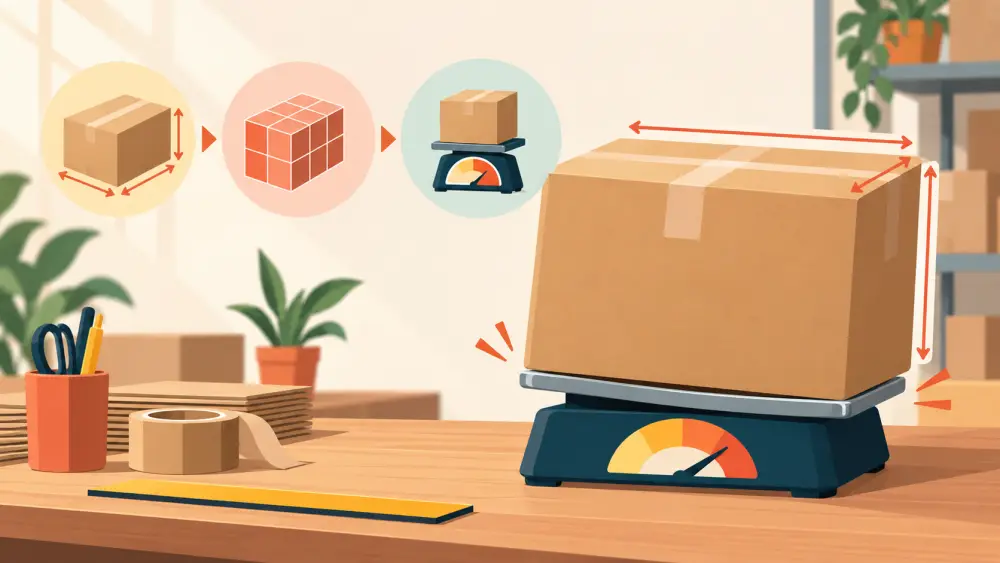
You weigh your parcel and it comes to 0.4 kg. Then the shipping charge comes back as if it weighed three times that. Nothing is broken. The courier is charging you for the space your box takes, not just its weight. This is called volumetric weight, and it catches many new sellers by surprise.
The idea in plain words
A courier vehicle has limited room as well as limited load capacity. A large box full of cushions fills the space but weighs almost nothing. To be fair to themselves, couriers calculate a weight from the box dimensions and bill you whichever is higher, actual or volumetric.
The formula
Measure the length, width and height of the packed box in centimetres. Then:
Volumetric weight in kg = length times width times height, divided by a divisor.
The divisor differs between couriers and services. Many use 5,000, but I have no way to tell what yours uses. Confirm it with your courier or check the terms in your shipping dashboard before you trust any calculation.
A worked example
Take a box measuring 30 cm by 20 cm by 10 cm.
- Multiply: 30 times 20 is 600, and 600 times 10 is 6,000 cubic centimetres.
- Divide by an assumed divisor of 5,000: 6,000 divided by 5,000 is 1.2.
So the volumetric weight is 1.2 kg. If the parcel actually weighs 0.4 kg, the billed weight is 1.2 kg, three times the real weight, because the volumetric figure is higher.
Shrinking the box pays off
Now see what a tighter box does. Suppose you find a box measuring 20 cm by 15 cm by 8 cm that still fits the product with protection.
- 20 times 15 is 300, times 8 is 2,400 cubic centimetres.
- 2,400 divided by 5,000 is 0.48 kg.
Now the volumetric weight (0.48 kg) is only a little above the actual 0.4 kg, and the bill follows the larger of the two, so you pay for roughly half a kilo instead of 1.2 kg. Same product, far less freight.
Practical steps for your shop
- Measure the outside of your packed box, not the product.
- Round up to the nearest centimetre, as couriers usually do.
- Keep a note of each box size and its volumetric weight.
- Compare it with the actual packed weight. The larger number is what you plan around.
- Ask your courier whether they round to the next half kilo or follow other slab rules.
If you also trim weight to fit a cheaper slab, our piece on trimming packaging weight pairs well with this one.
Where it bites hardest
Light, bulky goods feel the impact most: soft items, hollow containers, anything padded. Dense goods like jars or books usually bill on actual weight. If you sell fluffy products, choose box sizes carefully, and consider soft pouches where protection allows.
Share dimensions honestly
When you know your parcel size, put it into your own records and your product details so shipping quotes stay predictable. Our guide on product weight and dimensions explains what to write. For general guidance on moving parcels across the country, see shipping across India.
Quick checklist
Measure, multiply, divide by your courier's divisor, compare with real weight, and use the higher figure. Then ask whether a smaller box would work. A few centimetres taken off one side can be the cheapest saving you make all year.