
Do you need a weighing scale to ship from home?
Why a simple kitchen or parcel scale pays for itself in avoided surprises, and which features matter when you pick one, without brand or price talk.
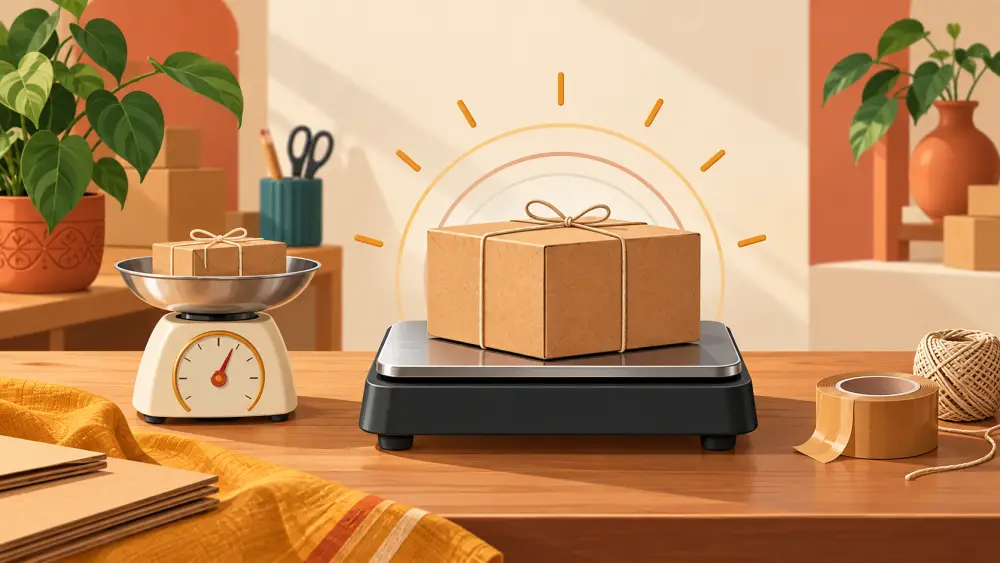
Short answer, yes. If you ship even a few parcels a week, a scale is one of the most useful tools on your packing table. It stops you guessing and gives you numbers you can trust.
What a scale saves you from
Without a scale you estimate weights from memory or from the product label. That leads to a few problems.
- You enter the wrong weight at booking, then face a different bill.
- You cannot tell which packing choices add weight.
- You cannot check a courier's weight claim against your own record.
- You cannot price shipping fairly because you do not know the real weights.
A scale turns all of these into simple checks.
Kitchen scale or parcel scale
Both can work.
- A kitchen scale is small, easy to find and good for light parcels. It usually reads in small steps, which helps for items near a weight limit. Its platform may be small, so large parcels may not sit steady.
- A parcel or postal scale has a larger platform and can handle heavier loads. Its steps may be larger, so it is better for medium and heavy parcels.
If you sell small, light items, the kitchen type may be enough. If you sell bulky or heavy goods, you may want a larger one. Many sellers end up with both.
What accuracy matters
Do not chase fancy specifications. Look for these basics.
- Display steps small enough for your lightest parcel. If most of your parcels weigh a few hundred grams, a scale that jumps in large steps will not help you.
- A capacity comfortably above your heaviest parcel, so you do not overload it.
- A flat, stable platform that can hold your biggest box without tipping.
- A tare button, so you can zero the scale with a tray or box on it.
- A clear display you can read in poor light.
Test it when you get it
Put a sealed packet with a stated net weight on the scale and see if the reading matches. Test it at different spots on the platform, and with a few items, to see if the readings are consistent. If the scale gives different numbers for the same object, send it back.
Use it well
- Place it on a flat, hard surface, not a soft cloth or a wobbly shelf.
- Let it settle before you read the number.
- Weigh the sealed parcel, not the bare product.
- Record the weight beside the order or product. The routine is covered in how to measure and weigh a parcel correctly.
Keep it healthy
Replace batteries before they run low, since weak batteries can cause odd readings. Keep the platform clean and dry. Avoid dropping heavy boxes on it, and store it flat.
What it does for your bills
A scale does not reduce shipping charges by itself, but it helps you spot where charges come from. When a bill looks higher than expected, your own weights are the first thing to check, as discussed in why the weight you declared differs from what was charged. It also helps you see how small changes in packing can move a parcel across a pricing step, as in the shipping weight slab trim example.
The bottom line
A basic scale costs far less than a few bad shipping bills. Choose one that matches your parcels, test it, and weigh every order. It is a small habit that makes your whole shipping process more predictable.