
How do I price different pack sizes fairly per ml or gram?
Selling the same product in 100 ml and 250 ml packs means checking the price per ml and the margin on each pack, so the bigger one rewards buyers without eating your profit.
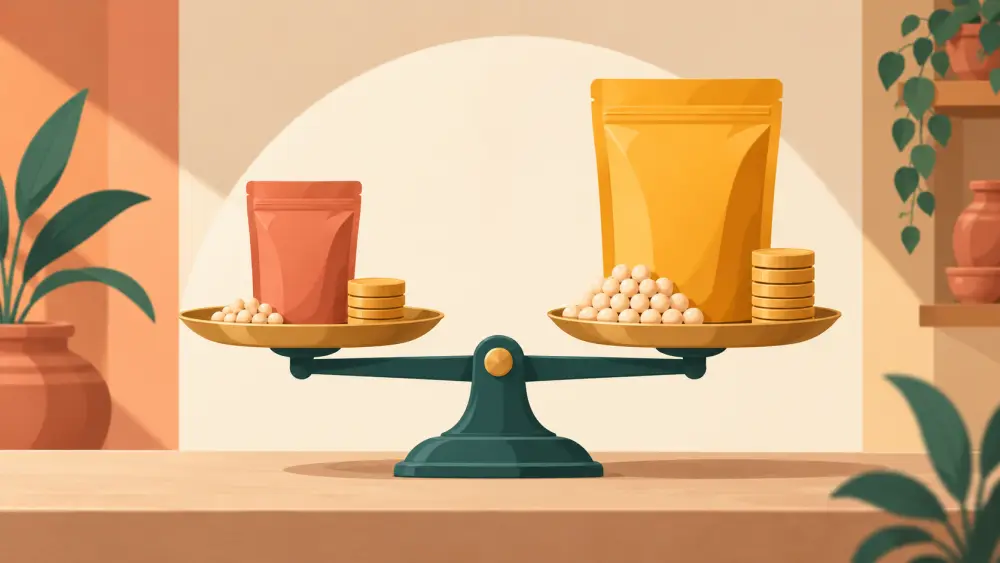
If you sell hair oil, a face serum, honey, ghee or any product that comes in more than one pack size, you will eventually ask yourself whether the big pack should simply cost "a bit less than two and a half small ones". Guessing works until a customer does the arithmetic for you. This post gives you a small method so you do it first.
Start with the price per unit
Take two packs of the same oil. The 100 ml bottle sells at Rs 250 and the 250 ml bottle sells at Rs 550.
- 100 ml pack: Rs 250 divided by 100 is Rs 2.50 per ml.
- 250 ml pack: Rs 550 divided by 250 is Rs 2.20 per ml.
So the big pack is cheaper per ml by Rs 0.30. That gap is the reward you are giving a customer for buying more. A buyer who compares quickly in their head sees "more oil, lower rate" and the larger pack feels fair. If the per ml price on the big pack were the same or higher, a careful buyer would feel cheated, and the big pack would sit unsold.
Check your margin on each pack
A fair-looking price is not the same as a profitable one. Now bring in cost. Say the 100 ml pack costs you Rs 120 all in (oil, bottle, label, packing) and the 250 ml pack costs Rs 250.
- 100 ml pack: Rs 250 minus Rs 120 leaves Rs 130 profit, about 52 percent of the selling price.
- 250 ml pack: Rs 550 minus Rs 250 leaves Rs 300 profit, about 55 percent of the selling price.
Here the big pack earns more rupees per order and a slightly better margin, even though it is cheaper per ml. That works because the bottle, label and packing do not grow in step with the liquid. Your cost per ml falls from Rs 1.20 to Rs 1.00, and you pass part of that saving to the customer.
Do this check every time you set up a new size. If the bigger pack ends up with a thinner margin than the small one, the small pack is subsidising it and you should look at the price again.
Things that quietly change the answer
Before you lock the prices, run through these:
- Shipping weight. A 250 ml bottle weighs far more than a 100 ml one, so your courier cost per order goes up. Count it, or the big pack's margin is smaller than it looks. See volumetric-weight-worked-example for how courier weight gets decided.
- Packaging. A bigger bottle may need a stronger box. Add it to the cost before you compare.
- Who buys which size. Trial buyers pick the small pack. Repeat buyers pick the large one. The small pack is often your marketing cost, so do not expect it to carry the highest margin.
A simple routine
- Write the cost of each pack in one column and the price in the next.
- Divide price by quantity to get price per ml or gram.
- Subtract cost to get profit, then divide profit by price to get margin.
- Make sure the larger pack has the lower price per unit and a margin that is not worse than the small pack.
If you need a refresher on turning a target margin into a price, price-from-target-margin-formula walks through it. And for sets of sizes sold as variants in one listing, how-many-variants-is-too-many is worth a read, because two or three sizes usually serve a small shop better than five.
Pack size pricing is a few minutes of arithmetic once, and it keeps you from the two common mistakes: a big pack that is not a better deal, and a better deal that is not profitable.