
Self-shipping vs using a shipping aggregator, the concept
Booking couriers yourself gives you control and direct relationships, while an aggregator gives you coverage and convenience, and the right mix depends on your volume and your time.
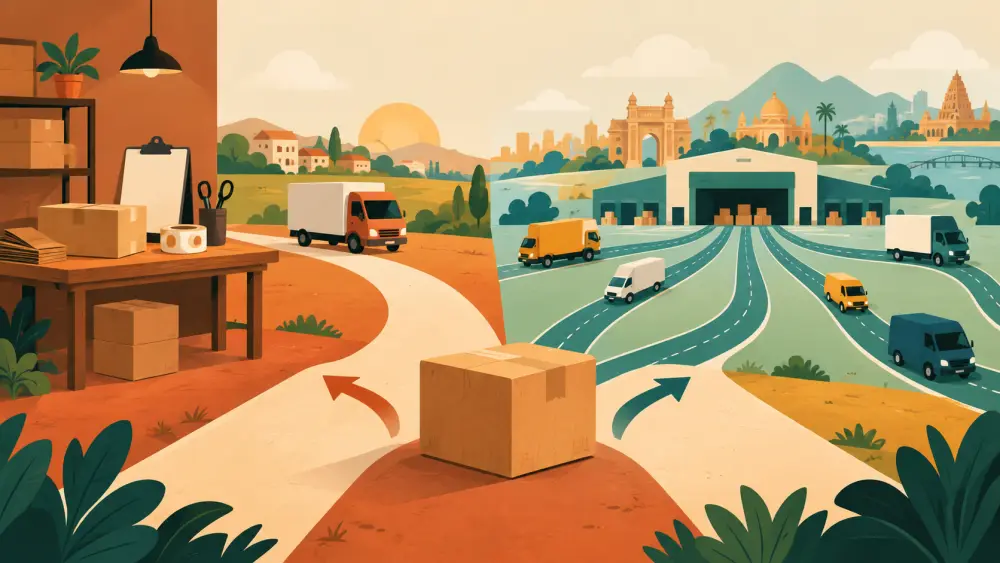
Sooner or later every seller asks how parcels should actually leave the house. Broadly there are two routes. You can deal with couriers yourself, or you can use a shipping aggregator, a service that sits between you and several couriers. Neither is right for everyone. This is a concept guide to help you see the trade-offs.
What self-shipping means
In self-shipping, you work directly with one or a few couriers or postal services. You open an account or walk into a branch, book each shipment, hand over parcels and deal with the courier's own support. You may also include delivering by your own staff or a local messenger, which is a separate case covered in when self-shipping makes sense for nearby local orders.
What an aggregator means
An aggregator gives you a single place to book shipments with different couriers. You usually enter the parcel and address details once, pick from the available courier options, and get labels and tracking from one dashboard. The aggregator handles the relationship with the couriers, and you deal with the aggregator for most things.
Control versus convenience
Self-shipping gives you a direct line. You choose the courier, you know the person who comes for pickup, and you decide how things are done. The cost is effort. Every extra courier means another account, another set of rules and another support contact.
An aggregator reduces that effort. You get one login and many options. The trade-off is that you are one step removed. If a parcel has a problem, you may be talking to the aggregator while they talk to the courier, which can add a layer.
Coverage
A single courier may not reach every pincode your customers live in. If you ship across India, you may find gaps. An aggregator that offers several couriers can help fill them, since an order that one courier cannot serve may be possible through another. If your customers are mostly in one city or region, one good courier may be all you need.
Effort and time
Think about your daily routine. Booking, labelling and tracking take time, and time is scarce for a small team. Tools that bring this into one screen can save minutes on every order, and those minutes add up. If you ship just a few orders a week, a simple direct arrangement may be fine.
Cash on delivery and remittance
If you take COD, how money gets back to you matters. Whether you work directly or through an aggregator, ask how collected cash reaches you and how you can track it. This affects your working capital. What COD remittance means for your cash flow goes into the idea, and cash on delivery without the chaos covers the day-to-day.
Cost, without numbers
Costs can come in different forms, such as per-shipment charges, weight rules, COD charges and return charges. Compare how each option calculates them rather than chasing a single figure, since the structure matters as much as the amount. Read the terms yourself and keep a copy.
A practical way to decide
Ask yourself a few questions. How many parcels do you send each week? How spread out are your customers? How much time do you want to spend on logistics? How much do you want direct control?
Many sellers start with one simple option, learn what they need and then change. Some keep both, using direct service for their most common route and an aggregator for hard-to-reach pincodes. Whatever you choose, test with real orders first and keep notes. For the broader picture, see shipping across India, what small brands should know.