
What COD remittance means for your cash flow
When a customer pays cash on delivery, the money reaches you later through the courier, and that gap between delivery and receipt is something you should plan your spending around.
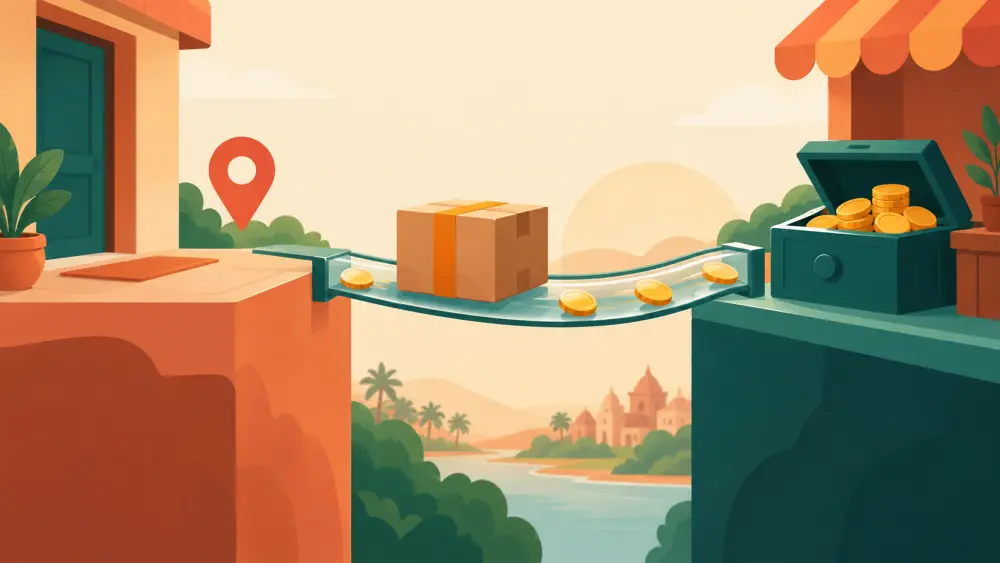
Cash on delivery feels simple. The customer pays at the door and you get paid. But the cash does not go straight into your pocket. The courier collects it, and it comes to you afterwards. That transfer is called remittance, and the wait before it arrives is a real part of your working capital.
What remittance means
Remittance is the courier or shipping partner passing the money they collected from your customers to you. You do not hand out the parcel and receive cash that same day. There is a process in between, where collections are totalled, matched against parcels and then sent to your bank account.
The gap that matters
Think of the time between three events.
- You spend money on materials, packing and shipping to prepare the order.
- The customer receives the parcel and pays on delivery.
- The collected amount reaches your account.
Between the first and the last is a stretch where you have spent money but not yet received it. If you are paying suppliers or buying stock in the meantime, you are using your own cash or savings to bridge that stretch. The longer or more unpredictable it is, the more it matters.
I will not tell you how long it takes, because it depends on who you work with and what you agreed. Ask your courier to explain their process and put the answer in writing, then watch how it behaves in practice.
An illustration with made-up numbers
Say you get 20 COD orders in a busy week, each worth Rs 800. That is Rs 16,000 of sales on paper. But if the cash only arrives after the parcels are delivered and the courier processes them, none of that Rs 16,000 is in your hand yet when your supplier asks for payment for the next batch. If you also had to pay for packaging and shipping labels up front, your account could look thin even in a good week.
Why it matters more for growing sellers
When you are small, the gap is easy to absorb. As orders grow, the amount waiting at any time grows too. Sellers sometimes feel "busy but broke" because most of their sales are sitting with the courier. For a deeper look, see COD payout delay and the cash gap and working capital, a simple formula for sellers.
How to plan around it
- Track COD separately. Keep a list of delivered COD orders and the amounts expected, and tick them off as money arrives.
- Match what arrives to what you expect. If a remittance is lower than your sheet, find out why, such as a charge or a missing parcel.
- Keep a cash buffer so that supplier payments do not depend on the next remittance landing on time.
- Avoid committing spend against money you have not received yet.
- Encourage prepaid orders where it suits you, with a small incentive or by making clear the benefits to the customer. See cash on delivery without the chaos.
Ask the right questions
When choosing a courier, ask how you can see which parcels have been collected and which are pending, how disputes are handled and what charges are deducted from what you receive. Questions to ask a courier before you start shipping has a ready list.
Remittance is not a problem, but it is a delay you must plan for. Seeing it clearly turns an unpleasant surprise into a normal part of your cash cycle.