
How do you pack glass jars and bottles for shipping?
Seal the lid, wrap each glass piece on its own, keep jars from touching each other and leave cushioning on all sides, which gives a parcel a better chance of arriving intact.
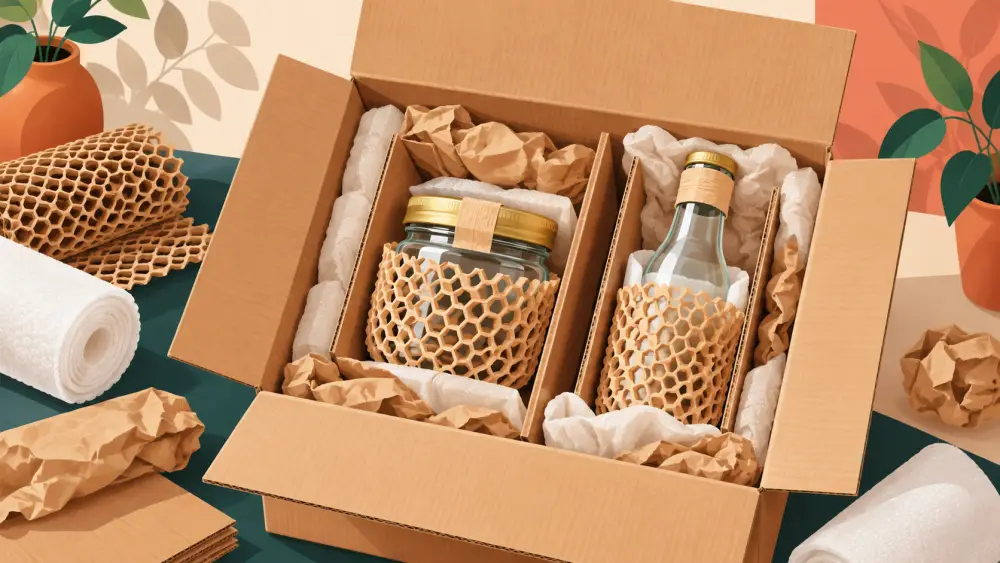
Glass has two problems in the post. It breaks if it is hit, and when it breaks it can spoil everything else in the parcel. Jars and bottles also have lids and caps that can loosen. Good packing handles both, and none of it needs special materials.
Start with the closure
Before you think about the box, check the jar itself.
- Tighten the lid fully, but not so hard that it cracks the thread.
- If the lid has a liner or inner seal, make sure it is seated flat.
- Add a layer of tape or a shrink band around the lid and neck, so it stays shut if it is jolted. Tape in a way that does not cover the label you need.
- For jars with liquids, wrap a small piece of cling film or thin plastic over the opening before putting on the lid, if it suits the product.
No closure can be promised to hold under every drop, so treat these as ways to reduce risk, not remove it.
Wrap each piece alone
Every jar or bottle should get its own wrapping before it meets any other item.
- Wrap with bubble wrap and go around at least twice. Cover the base and shoulders, which take most of the force.
- Tape the wrap so it does not unroll.
- Put the wrapped piece in a small plastic bag if you want to keep the packing dry in case of a leak.
Never let glass touch glass
When you send several jars, they should not touch each other or the walls of the box. Impact between two glass pieces is a common way for both to crack.
- Use dividers of corrugated cardboard between them. Cut strips to fit, or use a bottle sleeve.
- Stand bottles upright with cushioning below them, unless the product advice says otherwise.
- Pack the jars tight enough to avoid sliding but not so tight that pressure on the box is passed directly to them.
Cushion on all sides
Leave a few centimetres of padding between the glass and every wall of the box. That includes the bottom and the top. If a box falls on its corner, this space is what absorbs the knock. Fill the gaps with crumpled paper or air pillows until a gentle shake produces no rattle.
Pick a strong outer box
A glass parcel needs a sturdy corrugated box, not a soft mailer. For heavier jars, double the bottom with an extra piece of board. Seal all seams with strong tape. A second box around the first is worth thinking about for higher value items.
Mind the weight
Glass is heavy, and the extra padding adds more. Weigh the finished parcel and check it against your courier's slab before you promise a delivery charge to the customer. shipping-weight-slab-trim-example shows how a few grams can change the price.
Label and test
Label the parcel as fragile. Then, before you send a new product, do a test. Pack one, drop it gently from a low height onto a soft surface, and open it. If the jar is loose or cracked, add more cushioning. Test with an empty jar to avoid wasting product.
Related guides
For glass in photos, see how-to-photograph-glass-bottles-and-jars. For the basic layered method that applies to every fragile item, how-to-pack-fragile-items-for-courier is a good starting point. And if a parcel does arrive damaged, the cost is shown in cost-of-a-damaged-in-transit-parcel, which helps you decide whether stronger packing is worth the extra rupees.