
How to record product weight and dimensions for your listings
Measure the product and the packed parcel, record both, and use them for buyers and for shipping.
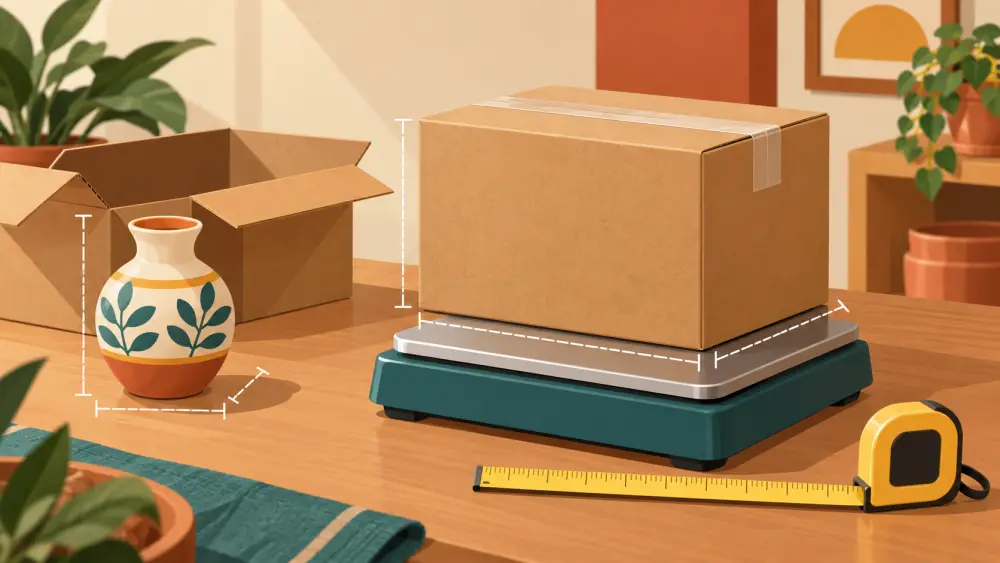
Weight and size look like boring details, but they serve two audiences. Buyers use them to picture the product. Couriers use the packed parcel to decide what shipping costs. Record both properly once and you will use them for years.
Two sets of numbers, not one
Measure each product twice:
- Unpacked: the product itself. This is what customers care about.
- Packed: the product inside its box or mailer with filler. This is what matters for shipping.
The difference can be large. A 200 g candle may be a 450 g parcel once it has a box, wrapping and a thank-you card. Do not use the product weight for shipping decisions.
How to measure
- Use a kitchen scale for weight. Weigh three units of the same product and note the highest.
- Use a metal or tailor's tape for length, breadth and height, at the longest points.
- For clothes, measure flat, and say so: "Chest 20 inches flat."
- For anything round, record diameter and height.
- Measure a finished, packed parcel with all contents included.
What to show to buyers
On the product page, list the dimensions that help someone decide:
- Length, width, height or diameter
- Weight, if it matters (a bag, a pot, a plant)
- Capacity for containers, such as 500 ml
- Size relative to something familiar, like "about the size of a small notebook"
Stay consistent in the units you use. Keeping product data consistent covers that habit.
What to keep for yourself
Record packed weight and packed dimensions in your planning sheet. Check the exact way the courier you use calculates charges directly with them, as methods differ and change over time. I am deliberately not quoting any weight slabs or rate rules here, because they are not something I can verify. For the general picture of the cost side, see shipping across India.
Measure again when packaging changes
A new box, thicker bubble wrap or an extra insert changes the parcel. Whenever you change anything in how you pack, weigh and measure one finished parcel again and update your sheet.
Be honest about tolerance
Handmade and natural items vary a little. If a plant pot is "about 15 cm", write "about 15 cm", not "15 cm". Buyers accept a small difference when you flagged it. They do not accept one you hid.
Why this prevents trouble
Wrong dimensions cause returns when a bag turns out too small, and surprises when a parcel is heavier than you declared. Both cost money. A few minutes with a scale and a tape, done properly, removes both problems. The column list that holds all of this is in catalogue spreadsheet columns every small seller needs.