
How to keep product data consistent across your whole catalogue
Small differences in units, capitalisation and attribute names make a store look careless. Simple rules to prevent them.
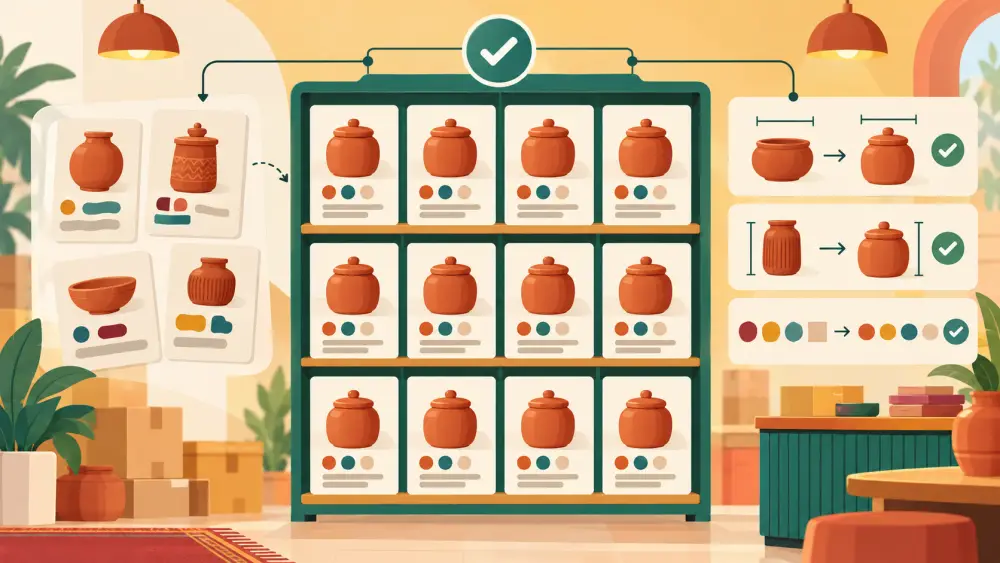
Customers rarely notice consistency, but they notice its absence. One product says "Cotton", another says "100% cotton", a third says "cotton fabric". Sizes appear as "M", "Medium" and "m". Individually trivial, together they make a store look assembled in a hurry.
Decide the rules once, write them down
Open a note called "catalogue rules" and fill it in before you list more than a few products. It should answer:
- How do I write a title? For example: "Material, product type, colour" and nothing else.
- Which units do I use? Centimetres or inches, grams or kilograms, but pick one for each.
- How do I capitalise? Title case for names, sentence case for descriptions, is a common choice.
- What is my fixed list of colours and sizes? Use those exact words, every time.
Units
Mixed units confuse buyers. If one listing gives length in inches and another in centimetres, people will mentally convert wrongly. Choose what your customers use most and apply it to every listing. Where a conversion helps, put it in brackets, but always in the same pattern.
Attribute names
Use one name per attribute. "Material" everywhere, not "Fabric" in one place and "Made of" in another. Keep the order the same too: material, size, care, then shipping note. When someone has read one of your listings, they should know where to look in the next.
Colour and size vocabulary
Make a short, fixed list. Instead of "Navy", "Dark blue" and "Midnight", choose one word for that shade and reuse it. For sizes, decide whether you write "XL" or "Extra Large" and stay with it. This also makes stock easier to count, as set out in stock per variant.
Titles that behave
- Keep length similar across products so your grid looks even.
- Lead with what the product is, not a brand slogan.
- Skip all-capital titles and decorative symbols.
Audit once a month
Every few weeks, scroll through your own store as a customer would. Look for the odd one out: a different tone, a missing weight, a price without a size. There is no automatic checker for this in the tools I reviewed, so the audit is a manual habit, and a quick one when your rules are written down.
Fix patterns, not individual products
When you spot a mistake, ask whether it appears elsewhere. If "Cotten" is misspelled in one listing, search your planning sheet for the same word. Fixing the pattern in your sheet means your next batch starts clean. The sheet itself is described in catalogue spreadsheet columns every small seller needs.
Why it matters beyond looks
Consistent data builds a quiet kind of trust. The store feels run by someone careful, which is exactly the impression a first-time buyer is looking for before they pay. That idea is explored in what a website says about a brand before anyone buys.