
Dead weight vs volumetric weight and why couriers care
Two ways of weighing the same parcel, what each one means, and why a carrier may bill you on whichever figure is higher.
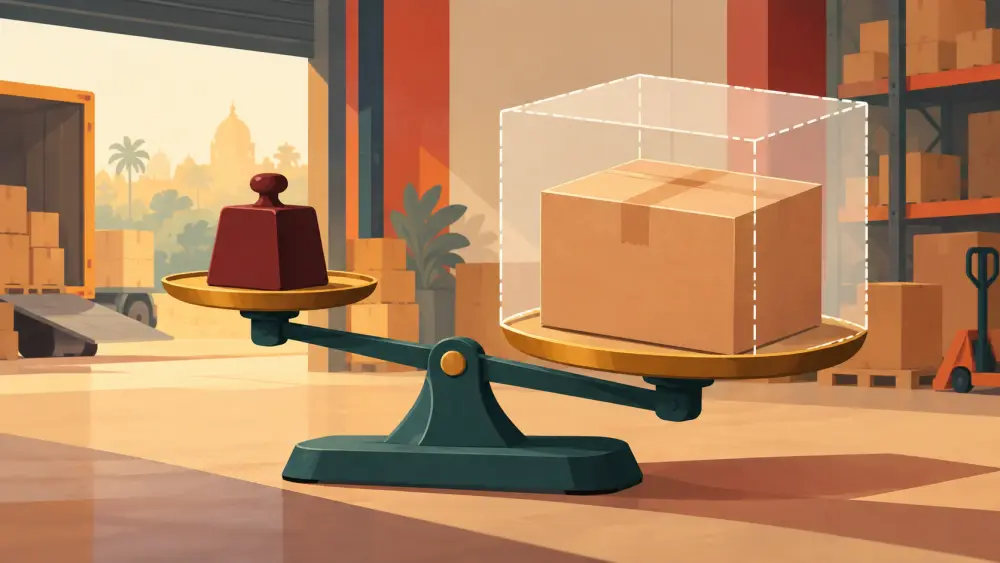
When a courier quotes a weight, they may be talking about two different things. Understanding both helps you read your shipping bill without guessing.
Dead weight
Dead weight, sometimes called actual weight, is what the parcel weighs on a scale. Packed product, box, filler, tape, invoice, everything that goes in the parcel counts. It is a physical fact and does not depend on how the parcel is shaped.
Dead weight is easy to understand, which is why sellers often rely on it alone when estimating shipping cost.
Volumetric weight
Volumetric weight comes from the size of the packed parcel, not from the scale. It converts length, width and height into a weight-like number using a method set by the carrier. The idea is to reflect how much space the parcel takes up.
A parcel can be very light on the scale and still have a large volumetric figure if the box is big. A tiny dense parcel will usually have a volumetric figure lower than its real weight.
Why a carrier uses both
Carriers have two scarce resources, load capacity and space. A parcel that takes up a lot of space but weighs little uses up space that could be used for other parcels. A parcel that is heavy but compact uses up load capacity. Looking at both figures lets them price each parcel fairly according to the resource it uses most.
Many carriers charge based on whichever figure is higher. I cannot tell you the exact rule your carrier follows, so look at your courier agreement or shipping dashboard rather than assuming.
A simple way to think about it
Picture two lines on a chart.
- One line is the real weight.
- The other is the space-based weight.
The one that sits higher is the one that tends to decide your charge. For some products the real weight will almost always win. For others, such as bulky soft items, the space figure will.
Where the confusion starts
Sellers often get confused in a few places.
- They weigh the product alone, not the packed parcel, and are surprised by the bill.
- They measure the box before adding bubble wrap or tape, so the real dimensions are larger.
- They do not realise that a box which looks slightly big can raise the space-based figure.
Always take your numbers from the finished, sealed parcel.
What you can control
You cannot change how the courier works, but you can change what you hand them.
- Pick a box that fits the product with just enough cushioning.
- Avoid air and bulky fillers when a thinner layer does the job.
- Keep the parcel as flat or compact as it safely can be.
- Use lighter materials where possible.
None of this should come at the cost of safety. A smaller box that cracks the product is not a saving.
Related reading
If you want to see how the space-based figure is worked out in practice, our post on a volumetric weight worked example walks through the maths. To see how small weight changes can alter what you pay, look at shipping weight slab trim example. And when you add products to your catalogue, how to write a product weight and dimensions section shows how to keep the figures tidy.
Keep a habit
For every product, note the dead weight and the packed dimensions together. Having both in one place makes quoting shipping and checking bills much easier.