
Is an exchange or a refund cheaper for me?
An exchange usually keeps part of the sale alive while a refund loses it entirely, and this worked example shows the difference in rupees.
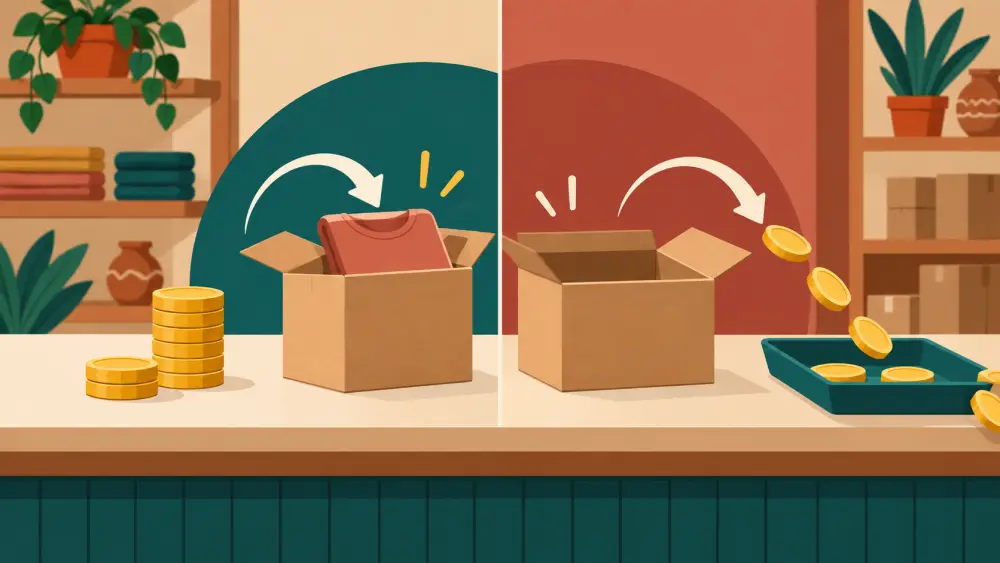
A customer writes to say the size is wrong, or the shade is not what she expected. You can offer a refund, or you can offer to swap the item. Which one is cheaper for you? Often it is the exchange, and the numbers show why.
The setup
Use illustrative numbers.
- The order earned Rs 200 profit after you paid Rs 70 to ship it to the customer
- Shipping the parcel back to you costs Rs 70
- Shipping a replacement out again costs Rs 70
- The returned item is in good condition and can be sold again
Option 1, the refund
The customer sends the item back and you refund her money.
- You paid Rs 70 to ship it out
- You pay Rs 70 to bring it back
- You earn nothing on the sale
Your result: a loss of 70 + 70 = Rs 140. The Rs 200 profit has vanished and in its place is a Rs 140 hole.
Option 2, the exchange
The customer sends back the item, and you send a replacement.
- Original shipping out, already counted inside the Rs 200
- Shipping back: Rs 70
- Shipping out the replacement: Rs 70
- Extra shipping for the exchange: 70 + 70 = Rs 140
Your result: 200 - 140 = Rs 60 profit. You still made a sale, only a thinner one.
The difference
Exchange leaves you with Rs +60. Refund leaves you with Rs -140. The exchange is better by Rs 200, which is the profit of the original order.
When the exchange stops being cheaper
An exchange only wins if a few conditions hold.
- The returned item can be resold. If it is damaged, the cost of lost stock is added to both options, and the exchange also needs a replacement.
- The replacement will fit or please the customer. A second exchange doubles your extra shipping, and the profit turns negative.
- The profit on the order is large enough to absorb the extra shipping. With a Rs 100 profit, the same exchange would leave you at minus Rs 40, still better than the refund's minus Rs 140.
Even then, the exchange is cheaper than a refund in most cases because it keeps the original profit as a cushion.
Giving customers the choice
You do not have to push for an exchange. Customers who do not want to wait for a second parcel may prefer the refund. But you can make the exchange easy and attractive, for example by checking sizes carefully before dispatch, or offering a small credit for choosing a swap.
Cut the exchange cost
- Ask the customer to share a photo before you accept the return, so you can confirm the issue
- Offer free exchange only when the problem is yours, and ask for the customer to bear return shipping for a change of mind, if your policy says so, stated clearly before the sale
- Confirm size and colour before dispatch to prevent the exchange in the first place
For the wider view of what a return costs, read how to calculate the full cost of a customer return. For the processes, cancellations, refunds and restocking helps you decide what to do when the item comes back.