
Returns and complaints when selling board games online and how to reduce them
Missing pieces and crushed boxes drive most board game complaints. Clear contents lists, photos of the real box and careful checks before dispatch prevent them.
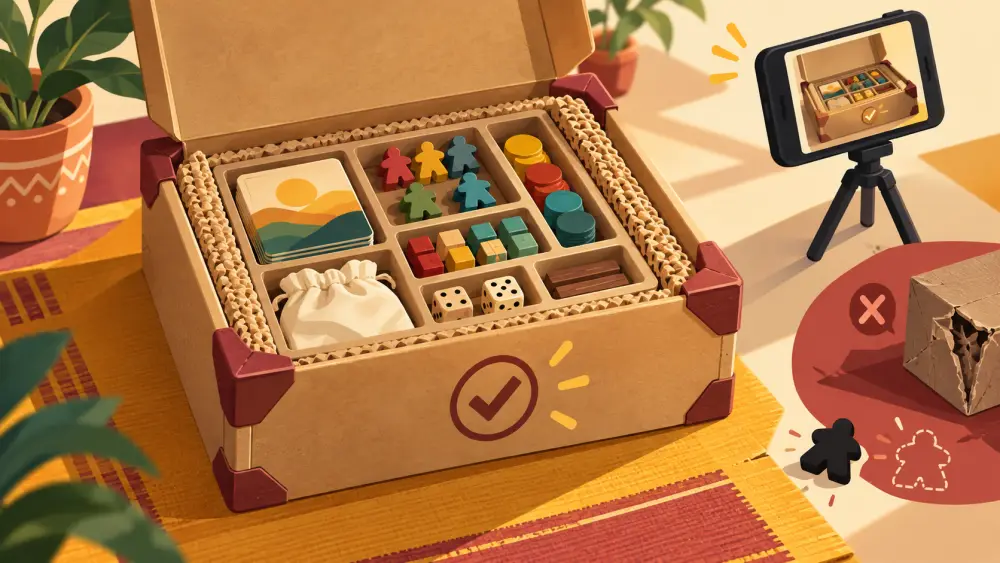
When a customer opens a board game and cannot play it, the whole purchase feels wasted. A missing dice, a short deck of cards or a crushed box makes them reach for the return button. These problems are predictable, so you can set up your process to catch most of them before the parcel leaves your hands.
List the contents precisely
On your product page, write every component and its quantity. For example, number of cards, tokens, boards, dice and rulebooks. If the manufacturer lists the contents on the box, copy it exactly. Add the player count, age range and play time as printed. A buyer who knows what should be in the box can compare on opening. Without a list, any gap becomes a dispute, and neither side can prove anything.
Show the real product
Use photos of the actual box and contents, as in photographing board games. If you sell used or open-box games, say so clearly, and show any wear on the box. State the language of the rules. A buyer expecting an English rulebook who gets another language is a clear source of returns, and that can be avoided with one line.
Check before you pack
For new, sealed games, check that the shrink wrap is intact and the box is undamaged. For open or pre-owned games, count every piece against the list and record it. A quick count before dispatch takes minutes and saves a long exchange later. If you cannot verify the contents, do not sell the game as complete.
Be clear about condition
Describe the box condition honestly. Say whether there are dents, tears or shelf wear. Many collectors care about this, and even casual buyers dislike surprises. A short grading note such as "sealed, new" or "box shows light wear" is enough. Do not claim a rare or collectible status unless you can support it.
Pack to avoid crushed corners
Crushed boxes are the second major complaint. Follow the steps in packing board games safely, with corner protection, a snug carton and wrapping against damp. Photograph the packed parcel, so you have evidence of how it left your table.
Write a fair policy for missing pieces
Decide how you will handle a missing component. You might send the piece if you can source it, offer a partial refund or accept a return for a full refund. Write the policy on your store, with a time window for reporting and the kind of photo you need. Our post on issuing a partial refund for missing items explains how to do this in your store. Check any consumer rights points with a professional.
Respond quickly and kindly
If a customer reports a problem, ask for a photo of the box and the contents. Reply the same day, say what you will do and keep your word. Many buyers accept a replacement piece or a partial refund if you handle it well, which costs less than a full return. Return shipping on a bulky game can be expensive, and a partial fix may suit both of you.
Keep notes and improve
Record each complaint and its cause. If a particular game often arrives short, check with your supplier. If boxes keep getting crushed in a certain region, upgrade the packing. Update your listing wherever a question keeps coming up. For the wider picture on what returns cost, see returns and RTO.
Careful checking is the quiet work that makes a board game seller trustworthy. When the box is neat and complete, the customer's first game night goes well, and they remember who sold it to them.