
What landed cost is and why it beats the supplier price
Landed cost adds freight and handling to the purchase price, so you price from what stock really cost you to get in hand.
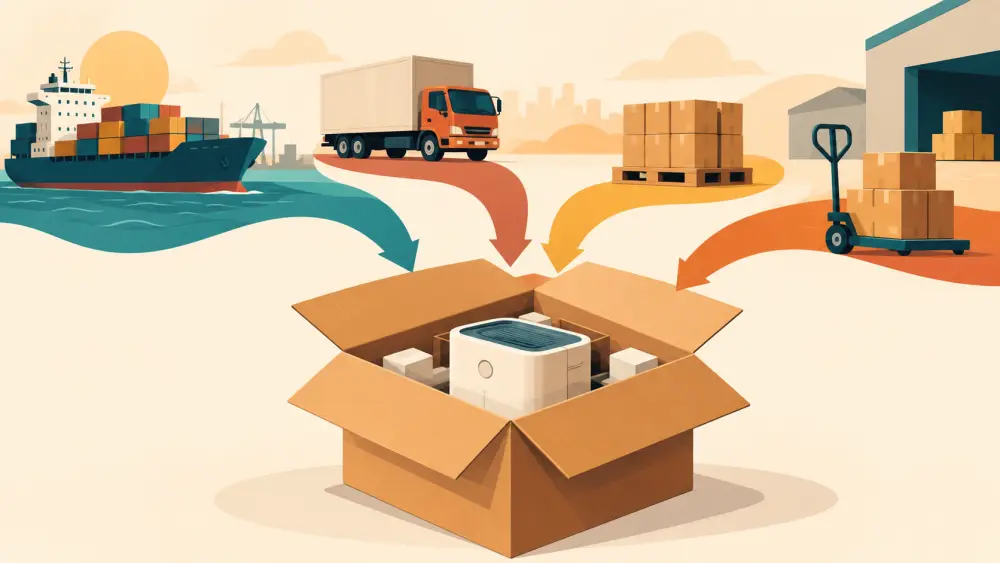
When a supplier quotes you Rs 200 for a product, that is not what the product costs you. It is what the supplier charges. By the time the box is sitting in your room, ready to sell, you have probably paid more. The full figure is called landed cost, and it is the number you should price from.
What landed cost means
Landed cost is the total you paid to get one unit into your hands, ready to sell. It is the purchase price plus everything you paid to bring it to you. Typical extras for a small Indian seller include:
- Freight or courier charges to bring the stock to you
- Unloading or local transport, such as an auto or a tempo
- Packing or labelling work you had to do on arrival
- Any fee charged by an agent or by a market for handling
You do not need every item on this list. Include the ones you really paid.
A worked example
Say you buy 50 units at Rs 200 each from a supplier.
- Purchase price: 50 x Rs 200 = Rs 10,000
- Inward freight: Rs 1,000 for the whole lot, which is Rs 20 a unit
- Unloading and local transport: Rs 500 for the lot, which is Rs 10 a unit
Landed cost per unit is Rs 200 + Rs 20 + Rs 10 = Rs 230. For all 50 units the total is Rs 10,000 + Rs 1,000 + Rs 500 = Rs 11,500, and Rs 11,500 divided by 50 gives the same Rs 230.
If you priced from Rs 200, you would think a Rs 300 selling price gives Rs 100 profit. At the true Rs 230, the profit is Rs 70. That Rs 30 gap on every unit is money you did not know you were losing.
Why the gap grows on small orders
Fixed charges get spread over fewer units on small orders. If the same Rs 1,500 of freight and unloading went with only 10 units, the extra would be Rs 150 a unit, not Rs 30. This is why small test orders from a distant supplier often look cheap on paper and expensive in reality. It is one reason to think about lot pricing from both sides, as a buyer and as a seller.
What to do with the number
Use landed cost wherever you used the supplier price. That means your margin calculations, your discount limits and your break-even sums. If you want to see how a lower real margin changes what you can offer, how a 10 percent discount hits profit shows the effect clearly.
Keep it simple in practice
You do not need software for this. For every purchase, note the invoice amount and the extras in one sheet, divide the total by the number of units, and save the result next to the product. When you add a product to your Varchas catalogue, you will be setting the selling price against a cost you have already checked.
Next step
Take your last stock purchase, add up every rupee that was spent on it beyond the supplier bill, and divide by the units. That is your landed cost. Compare it to the figure you were using before.