
"What is customer lifetime value? (and why repeat buyers matter)"
Customer lifetime value is the total a customer brings you over the time they keep buying, and it explains why a repeat buyer is worth more than a single big sale.
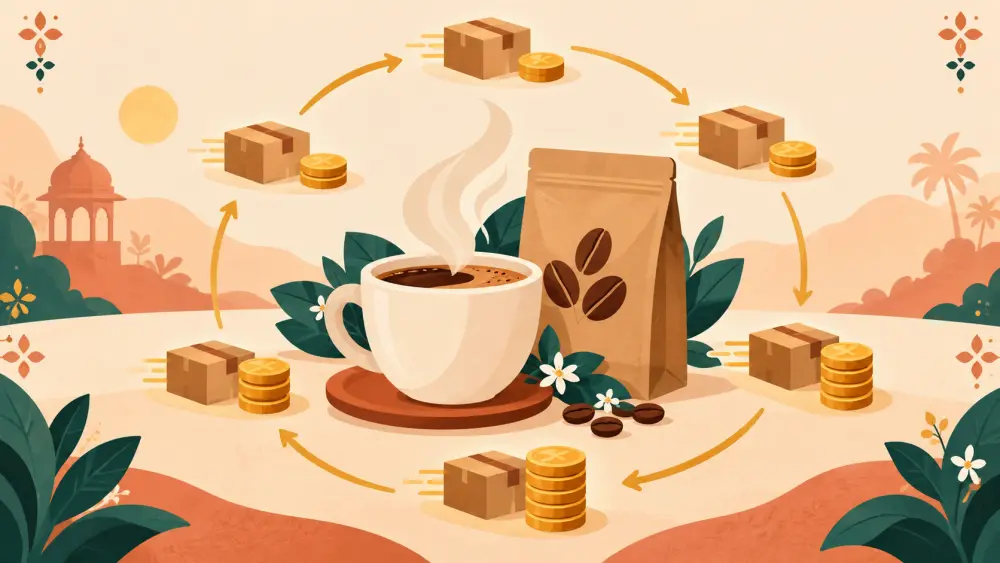
A sale to a new customer feels like the goal. But a customer who buys once and disappears is worth less than one who comes back. Customer lifetime value, often shortened to LTV or CLV, puts a number on that difference.
The definition
Lifetime value is the total value a customer gives your business across all their orders. You can measure it in revenue, or more usefully in contribution, which is what remains after the costs tied to those orders.
A simple version is this. Average contribution per order, multiplied by the number of orders a typical customer places.
I am not going to quote how often customers come back, because no honest universal number exists. Use your own order history.
A coffee buyer who reorders
Imagine you sell a 250 g bag of ground coffee for Rs 450. The numbers here are illustrative.
After product cost, packaging, shipping and payment charges, suppose each order leaves Rs 150 of contribution.
Now picture a customer, Arjun, who discovers your coffee and reorders every three months. Over a year, he places 4 orders.
- Revenue from Arjun: 4 x 450 = Rs 1,800.
- Contribution from Arjun: 4 x 150 = Rs 600.
His one-year value to you is Rs 600 in contribution, four times what his first order alone gave. If you spent Rs 300 to win him, the picture changes. After the first order, you are Rs 150 behind. After the second, you are even. The third and fourth are profit.
Compare that with a one-time buyer who ordered once and never returned. Her contribution is Rs 150 and your Rs 300 acquisition cost left you Rs 150 behind. A store needs a good share of customers like Arjun for the numbers to work. What is CAC covers how to find the Rs 300 figure.
Why this changes how you act
Once you think in lifetime value, a few habits make more sense.
- Packing and quality. A good unboxing makes a second order more likely. The repeat customer is the whole business makes this argument.
- Contact details. If you have a customer's email, you can tell them about restocks and new drops. Building an email list from day one and why email still beats every other channel for repeat sales go into it.
- Consumables. Products that run out, like coffee, tea, soap and skincare, naturally lead to reorders. Others, like a statement lamp, rarely do, so their lifetime value rests on a first purchase and referrals.
- Problem handling. A late parcel handled kindly can keep a customer. One handled badly loses them and their friends.
Do not over-trust the maths
Lifetime value is built from guesses about the future. Be careful.
- Do not assume every customer behaves like your best one. Use an average of real customers, and look at how many came back.
- Use contribution, not revenue, or you will overestimate.
- Count refunds and returns.
- Be cautious with small samples. Ten customers do not make a trend.
How to estimate yours
Export your orders. For each customer, count their orders and sum their contribution. Then look at the customers who started three or six months ago and see how many came back. Even a rough view, such as out of the 40 who bought in January, 8 have ordered again, gives you something real to work with. Cac payback with repeat orders uses the same idea for ad decisions.
Lifetime value is a reminder to build a shop customers return to, not just one that makes a first sale and waves goodbye.