
How long until a customer pays back what I spent to get them?
When ad cost per new customer is higher than first-order profit, repeat orders have to close the gap, and a little arithmetic shows how many customers must come back.
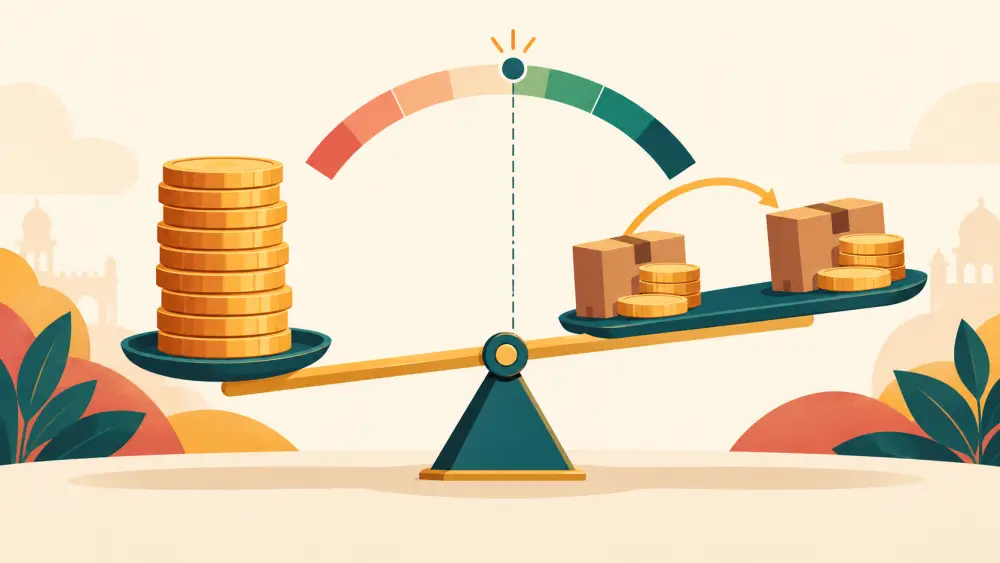
Sometimes you pay more to win a customer than their first order earns you. That sounds like a mistake, but many healthy shops run this way on purpose. What matters is whether enough customers come back to cover the gap, and that is something you can calculate.
The gap on the first order
Say you spend Rs 250 in ads and offers to win one new customer. This is your customer acquisition cost, or CAC. Their first order leaves Rs 180 contribution, which is what remains after product, packing, shipping and fees.
- Rs 180 minus Rs 250 is a loss of Rs 70 on the first order.
You are Rs 70 behind on that customer. The question is how long it takes to catch up.
One repeat order closes it
If that customer comes back and buys again, and the second order also leaves Rs 180, then:
- Rs 70 loss, plus Rs 180, leaves Rs 110 net.
So a single repeat order turns a loss into a gain. The second order has almost no acquisition cost, because the customer already knows you. That is why repeat buyers are so valuable. the-repeat-customer-is-the-whole-business talks about this idea in more detail.
What share of customers must come back
You cannot be sure a given customer will return, but you can look at the average across many. You need to recover Rs 70 per customer, and each repeat order brings Rs 180.
- Rs 70 divided by Rs 180 is about 0.39.
So on average you need about 0.39 repeat orders per customer. In plain terms, around 39 out of every 100 customers must buy at least once more for the group to break even. If only 20 of 100 come back, you are still behind. If 60 of 100 do, you are comfortably ahead.
You can do the same check with your own numbers. Divide the first order loss by the contribution of a repeat order. The result is the repeat rate you need.
Make sure you can measure it
To use this method you need to know how many customers actually reorder. Export your orders and see how many customers appear more than once over, say, the last three or six months. If you have not been tracking this, start now. A shop with few orders will have a rough figure, and that is fine. It still tells you which side of the line you are on.
Ways to improve the payback
- Raise first order contribution with a higher price or a bundle, so the loss is smaller. See bundle-price-vs-separate-price-profit.
- Lower acquisition cost by improving the ad, the landing page or the offer.
- Bring customers back sooner with an email or a WhatsApp message after delivery. building-an-email-list-from-day-one is a good place to start.
- Sell products people use up and need again, such as skincare, tea or oil, rather than one-time items.
A caution on optimism
Do not assume every customer will return just to justify an ad budget. Use your real repeat rate, and if you have little data, use a cautious guess. A simple rule is to treat the first order as the break-even target and treat any repeat orders as a bonus.
If you want to know the highest acquisition cost your first order can carry, maximum-cac-from-first-order-contribution covers that side of the question.