
"What is a shipping label? (and what must be on it)"
A shipping label is the sticker on your parcel that tells everyone along the route who it is for, where it goes and which order it belongs to, so it needs to be clear and readable.
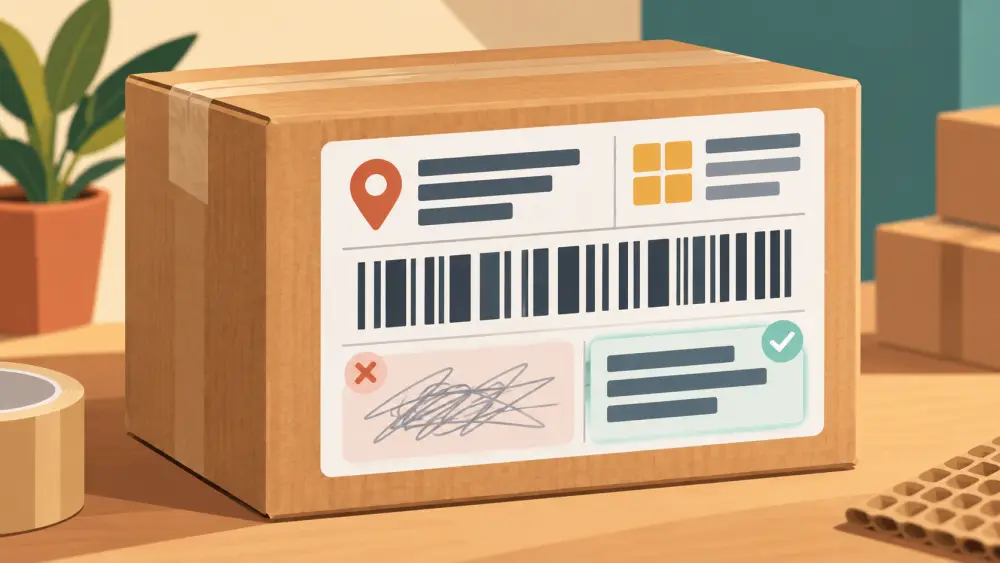
If you have only ever sent parcels with a handwritten address on a brown cover, the phrase "shipping label" can sound like extra paperwork. It is simply the sticker or printed slip on the outside of the parcel. Everything a stranger needs to move that parcel from your table to your customer's door should be readable on that one surface.
What a label usually carries
Labels vary by courier and by how you ship, so treat this as a general picture rather than a rule book. A useful label tends to include:
- The customer's name and phone number.
- The full delivery address with pincode.
- Your own name and return address, so a parcel that fails can find its way back.
- Your order ID, so you can match the parcel to the order in seconds.
- A tracking number, often called an AWB, when a courier has been booked.
- A barcode that scanners along the route read automatically.
Not every label has every item, and what a particular courier wants is something to confirm with them directly. The point is the job each item does. The address gets the parcel to the door, the phone number lets a delivery person call when the lane is confusing, and the order ID and AWB let you and the customer talk about the same parcel.
A handwritten example versus a printed one
Picture two parcels leaving your home on the same evening. The first has an address written in marker, slightly smudged where the cover rubbed against another bag. The pincode has a seven that looks like a one. The second has a printed label with the address in clear type, the pincode large, and a barcode underneath.
When the first parcel reaches a sorting point, someone has to squint and guess. A wrong guess means a detour or a delay. A barcode on the second parcel can be scanned in a second, and the address is readable even to someone who has never seen your neighbourhood. Neither is guaranteed to arrive faster, but the printed one removes a whole class of avoidable mistakes. If you want a deeper look at writing the address part well, see how to write a clear delivery address.
Why legibility matters more than good looks
A label does not have to be pretty. It has to survive handling. A few habits help:
- Print in black on a plain background rather than light grey or coloured paper.
- Stick it flat on the largest face of the box, away from edges and seams where it can peel or tear.
- Avoid placing it across tape joins where it can lift.
- Keep the barcode unfolded and uncovered. A crease through a barcode can stop it scanning.
For a bag or soft packet that can get wet, a clear tape strip over the label can protect it, as long as the tape does not make the barcode glare.
Labels and your own store
When you book a courier through an aggregator, the label is typically created for you and you print it. In Varchas Stores, a shipment record can hold an AWB and a label link, and orders can be booked through Shiprocket, so the label usually comes from that booking. If you ship a local order yourself, you still need your own label with the address and order ID. The habit is the same either way. Check the label against the order before you seal the box. If you want a routine for that, pick, pack and hand over, a simple checklist covers it.
A quick check before every handover
Hold the parcel at arm's length. Can you read the pincode and phone number without effort? Does the order ID match the item inside? Is your return address on it? If any answer is no, redo the label now. It takes a minute, and a failed delivery costs far more than that.