
What is repeat purchase rate? (and how to track it by hand)
Repeat purchase rate is the share of your customers who buy from you more than once, and you can count it yourself from an order export in about twenty minutes.
The plain meaning
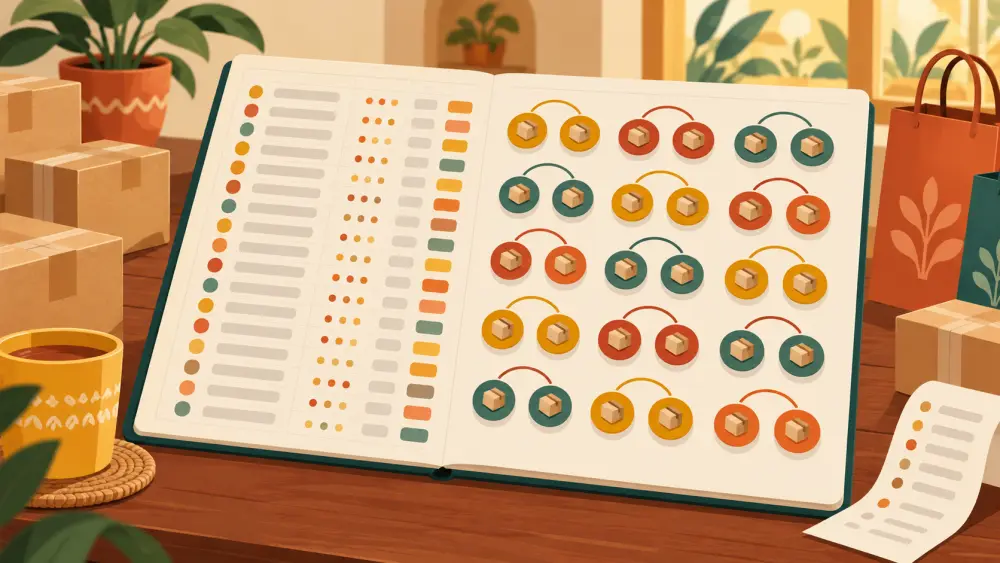
Repeat purchase rate answers one question: out of everyone who has bought from you, how many came back and bought again? It is a share of customers, not a share of orders. That difference trips up many sellers, so hold on to it.
If you have 40 customers and 12 of them have placed two or more orders, your repeat purchase rate is 12 out of 40, which is 30 percent. The 12 could have placed 2 orders each or 5 orders each. For this number it does not matter. Each person counts once.
That 30 percent is only an illustration. Your own figure will be whatever your own orders say, and a young store will often show a small number simply because customers have not had time to return yet.
Why a small seller should care
Getting a new customer usually costs you effort or ad money. A returning customer already trusts you, already knows your packing, and often needs no convincing. Knowing how many people return tells you whether your product and delivery experience are good enough to earn a second order. Our post on why the repeat customer is the whole business goes into the thinking behind this.
A low number is not a verdict. It is a pointer. Maybe the product is something people buy once a year, like a wall clock. Maybe your follow-up is missing. Maybe the first parcel disappointed them.
How to count it by hand
You do not need software beyond a spreadsheet. Here is the method.
- Export your orders. If you sell on Varchas Stores, the post on exporting store orders to a spreadsheet shows how to get the list.
- Pick one column that identifies a person. Phone number is usually best for Indian sellers, because the same person may use different email addresses or spell their name differently.
- Remove cancelled and refused orders so you only count orders that were actually delivered and kept.
- Sort the sheet by phone number so repeats sit next to each other.
- Count the unique phone numbers. That is your total customers.
- Count how many of those numbers appear more than once. That is your repeat customers.
- Divide repeat customers by total customers and multiply by 100.
In the 40-customer example, the sort would show 12 phone numbers appearing on two or more rows. 12 divided by 40 is 0.3, so 30 percent.
Pick a time window and stick to it
Repeat rate depends heavily on the period you look at. Someone who bought last week has not had a chance to return. Choose a fixed window, for example everyone whose first order was at least 90 days ago, and measure the same way each time. Then you can compare this quarter with the last one honestly.
What to do with the number
- Look at what the repeaters bought first. If most of them started with one particular product, lead with it in your Instagram posts.
- Look at the gap between first and second orders. If most people return after about a month, that is when to send a gentle WhatsApp reminder.
- Read the first-order reviews and complaints of those who never came back, and fix the pattern you see.
For ideas on prompting that second order, read how to encourage a second purchase after the first.
Keep it simple
Do not track this daily. Once a month, with a fresh export, is plenty. Write the three numbers down in a notebook: total customers, repeat customers, the percentage. After a few months you will see a trend, and that trend is more useful than any number you could borrow from another business.