
What is a payment gateway? (and how it differs from a bank account)
A payment gateway is the service that accepts UPI and card payments on your store's behalf and then passes the money on to your bank account.
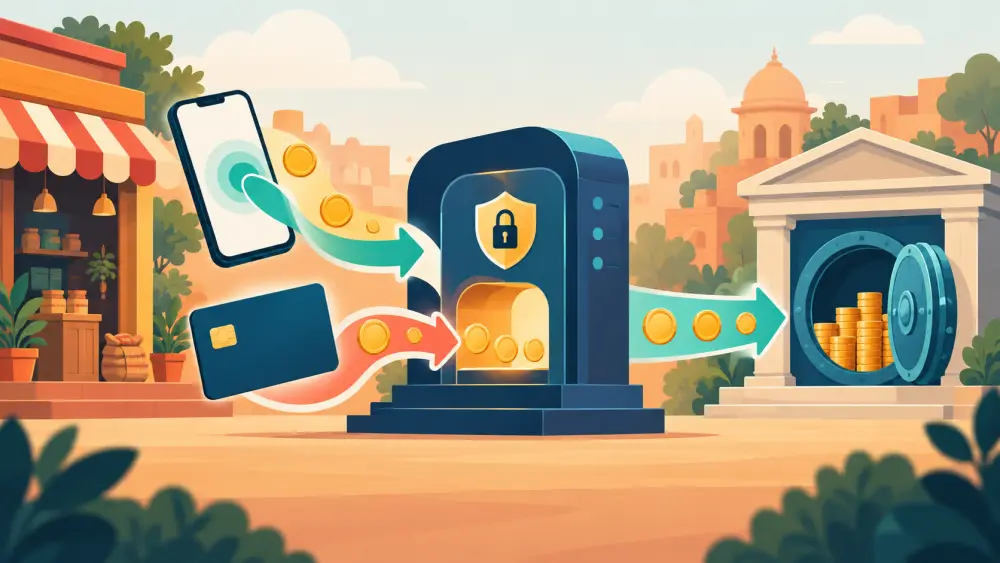
A payment gateway is the middle layer between your customer's money and your bank. A shopper wants to pay with UPI or a card. Your bank account cannot directly show a "pay now" screen on your website. The gateway can. It presents the payment options, collects the payment securely, and then arranges for the money to reach you.
Think of a shop counter
When you pay at a physical shop, there is a counter with a card machine or a UPI QR. That counter is not the shop's bank. It is the point where the payment happens, and the money later ends up in the shop's account. A payment gateway is the online version of that counter.
Your bank account, by contrast, is where your money rests. It does not do the job of accepting payments from strangers on a website.
The difference in one line each
- Bank account: where your money is held.
- Payment gateway: the system that takes a customer's payment online and sends it toward your bank account.
You usually need both. The gateway needs to know which account to pay into, which is why it asks you for your bank details and verifies you. What is KYC for online payments explains that part.
What the gateway handles for you
- Showing the payment screen with options such as UPI and cards.
- Keeping sensitive details like card numbers away from you.
- Telling your store whether a payment succeeded or failed.
- Collecting your money and paying it out to your account.
This lets your store mark an order as paid without you checking your phone for a bank message.
Gateway versus direct UPI
Some sellers just share a UPI QR on WhatsApp and match payments by hand. That works at a small scale, and it has costs of its own: you have to check each payment yourself. Marking WhatsApp orders as already paid via UPI shows how to record those. A gateway automates the matching for orders placed on your store.
What Varchas uses
The Varchas code integrates Cashfree for online payments, and the admin has a payment setup step for it. Orders can also be COD or part-paid with a Cashfree advance and the balance on delivery. I could read how these methods are labelled, so I can say that Cashfree is the gateway here. For how it works in practice, see UPI and COD payments for your own store.
Fees and timing
Gateways charge for their service, and payouts reach your bank on their own schedule. I will not quote any fees or how many days that takes. Read your gateway's current terms for both, and plan your cash flow around the slowest case. What is a settlement covers the payout side.
Questions to ask before choosing one
- What does it cost per payment?
- How and when do payouts reach my account?
- What documents will it need from me?
- What happens if a customer disputes a payment?
- Who do I contact when something goes wrong?
Next step
Write down the five questions above and find the answers on your gateway's own pages. Keep the answers in a note on your phone.