
What is a discount code? (and how to use one without losing money)
A discount code is a short word a customer types at checkout to get money off, and a quick margin check tells you how generous you can safely be.
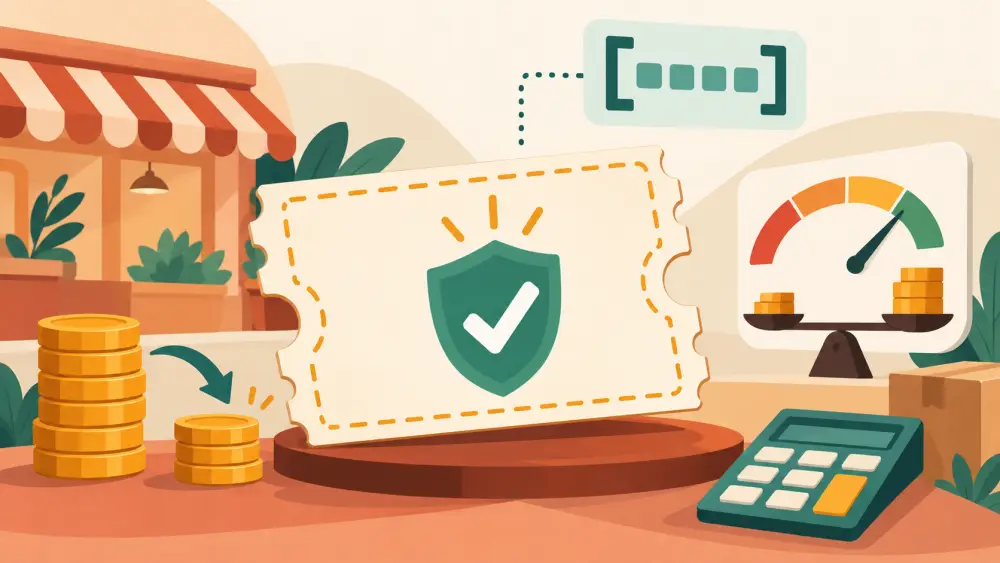
What a discount code does
A discount code, also called a coupon, is a short word or phrase such as WELCOME100. The customer enters it at checkout and the order total drops by a set amount or percentage. It lets you give a deal to specific people, like first-time buyers or followers from one Instagram post, instead of lowering your price for everyone.
Two common types
- Flat off: a fixed rupee amount, like Rs 100 off.
- Percentage off: a share of the order, like 10 percent off.
Either way, the real question is whether you still make money after the discount.
A Rs 100 off margin check
Say you sell a candle for Rs 599. It costs you Rs 250 to make and pack, and delivery is paid by the customer. Without a code, your margin is Rs 349.
With a Rs 100 off code, the customer pays Rs 499 and your margin is Rs 249. You gave up about 29 percent of your margin on that order, since 100 divided by 349 is roughly 0.29. You are still profitable, but the cushion for payment fees, returns and your own time is thinner.
Now imagine the same code on a Rs 299 product costing Rs 200. The margin before the code is Rs 99. After the code you are at a loss of Rs 1. A flat code that is fine on a big product can quietly sink a small one. That is why many sellers set a minimum order value, and why you should know your floor before you publish the code. See maximum safe coupon value calculation for a simple way to find it.
What Varchas Stores supports
In the admin Coupons screen, when you create a coupon you can set:
- A code made of letters and numbers only, up to 24 characters. It is stored in capitals.
- A type: percentage or flat rupees. A percentage must be a whole number from 1 to 100.
- A value.
- An optional maximum number of uses.
- An optional expiry date.
- An active switch, so you can switch a code off without deleting it.
If a coupon has already been used on an order, the admin asks you to deactivate it instead of deleting it. The coupon form has no minimum order value field, so if you need that protection, keep the value of the code modest relative to your cheapest product, or use the maximum uses limit to cap your exposure.
Keep the budget visible
A maximum uses limit works like a budget. If you allow 50 uses of a Rs 100 code, the most you can give away is Rs 5,000. Decide that figure first, then set the limit. Our post on coupon budget from expected redemptions walks through it.
Habits that protect you
- Give each code a purpose: one for a launch, one for a creator, one for returning customers.
- Put an expiry on anything that is meant to be temporary.
- Avoid letting customers stack different offers on one order. See the risk of stacking two coupons.
- Keep a note of what each code cost you, and which orders it brought.
A code is a tool for a specific moment. Used with intent it brings in a first order. Used loosely it teaches customers to wait for a discount.