
How do I budget a coupon campaign before I launch it?
Estimate how many people will redeem a code, multiply by the discount, and compare that bill with the extra profit those orders bring.
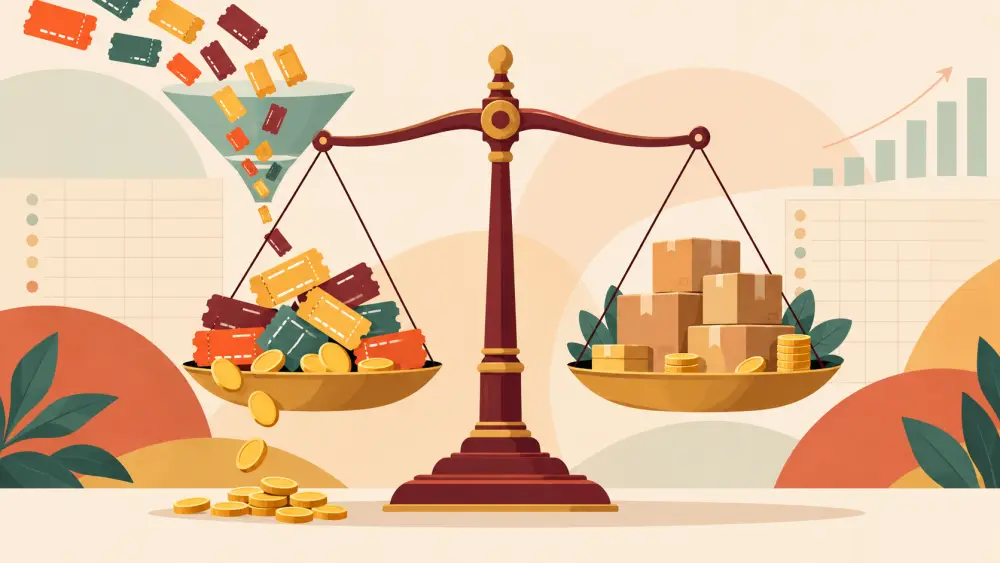
A coupon feels free because no money moves when you create it. The money moves later, one order at a time. A budget lets you see that total bill before you send the code to anyone.
The three numbers you need
You need only three estimates: how many people will see the code, what share will use it, and how much each use costs you.
Say you plan to send a code to 500 contacts on your WhatsApp broadcast and Instagram list. You assume 12 percent will redeem it. Twelve percent of 500 is 60 orders. Each order gets Rs 80 off.
60 orders times Rs 80 is Rs 4,800. That is the maximum you have committed to give away. Write it down as a campaign budget, the same way you would for an ad.
The 12 percent is a guess, so test it
Nobody can tell you the real redemption rate for your list. Treat 12 percent as a placeholder. Do the sum three times with a low, middle and high guess, say 5, 12 and 20 percent. That gives 25, 60 and 100 orders, and a discount bill of Rs 2,000, Rs 4,800 and Rs 8,000.
If the high case would hurt, put a limit on the offer, a last date, or a fixed number of uses. Your first campaign will teach you your real rate. Note it down for the next one.
Compare the bill with the profit
The Rs 4,800 only makes sense next to what those orders earn. Suppose each order brings Rs 300 of contribution before the coupon, meaning price minus product cost, shipping and packing. Sixty orders bring Rs 18,000. After the Rs 4,800 coupon bill you are left with Rs 13,200.
That looks great, but it is too generous. Some of those 60 buyers would have ordered anyway, at full price. Be honest and assume that half would have bought without the code. Then only 30 orders are extra. Thirty extra orders at Rs 300 is Rs 9,000 of new contribution, set against the full Rs 4,800 you paid out, because you discount the loyal buyers too. Net gain, Rs 4,200.
If you assume that three out of four would have bought anyway, only 15 orders are extra. Fifteen times Rs 300 is Rs 4,500, which is less than the Rs 4,800 bill. Now the campaign loses money. This is why the share of buyers who would have come anyway matters more than the headline redemption rate.
Ways to keep the bill under control
- Set a minimum order value so the discount is a smaller part of each cart.
- Put an end date on the code so it creates a reason to act now.
- Send it to people who have not bought for a while, not to your most loyal customers.
- Use a rupee amount rather than a percentage, so large carts do not blow the budget.
- Stop and review once the first 20 redemptions are in.
After the campaign
Compare the real numbers to your plan. How many redeemed? What was the average order value? How many of them were first-time buyers? Keep a simple note for each campaign so that the next budget starts from facts.
For the ceiling on any single coupon, see the biggest coupon you can offer without losing money. To decide whether to discount at all, read coupons that actually move stock. And if your list is small, building an email list from day one is how you grow the audience you can send a code to.
A coupon campaign is a spending plan. Write the budget before you press send.