
How to present size guides for footwear, rings and bangles
Footwear, rings and bangles each need a different measuring method, so explain how to measure at home and be careful before you promise any size conversion.
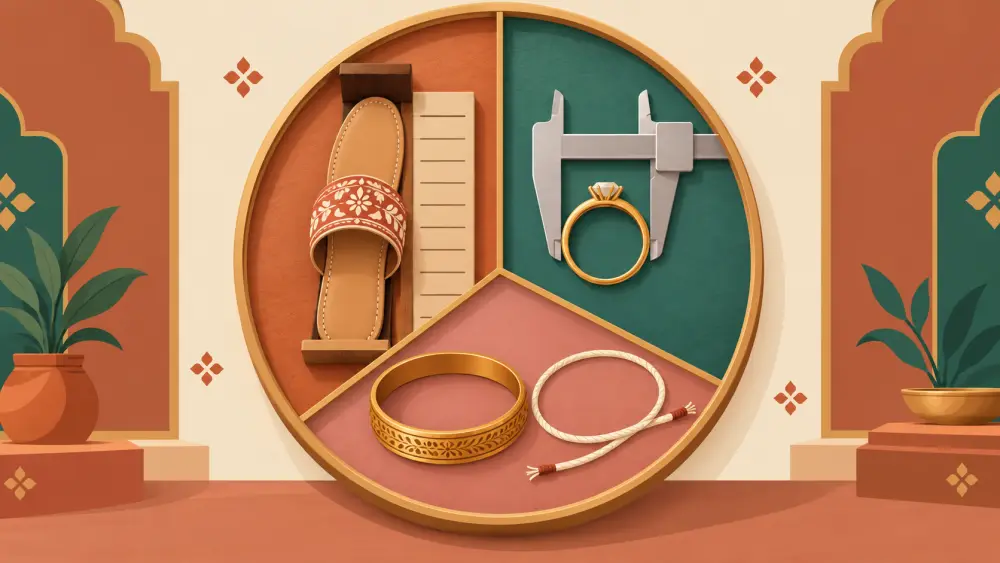
Shoes, rings and bangles are items where an almost-right size is still the wrong size. A shoe that pinches, a ring that will not pass the knuckle, a bangle that will not go over the hand: each one is a return waiting to happen. Because buyers cannot try them on, your size guide must teach them how to measure. Each product needs its own method, so let us take them one at a time.
Footwear
For shoes and sandals, the most useful number is foot length. Ask the buyer to stand on a sheet of paper against a wall with the heel touching the wall, mark the tip of the longest toe, and measure from the wall to the mark. Doing it in the evening, when feet are a little larger, and measuring both feet and using the larger one are sensible tips.
Then show your own inside length for each size. Measure the insole of your actual shoes and list it in centimetres. Buyers can compare their foot length with your insole length, and add a little room as suits the style. Say something like "leave about a thumb's width in front" only if it suits the shoe type.
Do not assume that the number on a size label means the same across brands, lasts or countries. Avoid a long conversion table of UK, US and EU sizes unless you have verified every number against your own products with your supplier. If you do mention them, say they are approximate. For presenting footwear well, read how to photograph footwear for an online listing and how to start selling footwear online in India.
Rings
Ring sizing is fiddly, and the best guide is an inside diameter or inside circumference of your actual rings. Explain two simple home methods:
- Paper strip: cut a thin strip of paper, wrap it around the base of the finger, mark where it overlaps, and measure the length against a ruler.
- Existing ring: take a ring that fits the same finger well, and measure its inside diameter across the widest inner point.
Then list the inside diameter or circumference for each of your sizes. Mention that fingers swell with heat and activity, and that wide bands fit tighter than thin ones, so buyers might choose a size up for a broad band. Say this as a tip, not as a rule. If you offer resizing or custom sizing, explain how and how long it takes. Our post on photographing earrings and rings up close helps with images that show the inner band.
Bangles
Bangles have to pass over the widest part of the hand, so the measurement depends on the hand, not the wrist. A typical method:
- Bring the thumb and little finger together tightly, as if putting on a bangle.
- Measure across the widest part of the hand, across the knuckle line, in a straight line.
- Compare with the inside diameter of your bangle sizes.
Alternatively, buyers can measure the inside diameter of a bangle that already fits well. Measure your bangles across the inside, from one inner edge to the opposite, and list this for each size. Explain whether your sizes are in inches, in centimetres or in a code, and note that rigid bangles do not stretch while some designs have a little flex. Say which yours are. See how to start selling jewellery online in India.
Make the guide easy to use
Put a short "how to measure" box on each product page, with three or four steps in plain words. A clear size chart image for phones helps too. How to design a clear size chart image for mobile screens shows how.
Offer help with sizing
Invite uncertain buyers to message you their measurement. For rings and shoes, a photo of a paper strip or a ruler beside the foot can settle it. Treat each question as feedback: if many people ask, the guide needs to be clearer.