
How do I include photography and sample costs in my price?
Spread the cost of a photo shoot and samples over the units you expect to sell, then check what happens to your margin if fewer pieces actually sell.
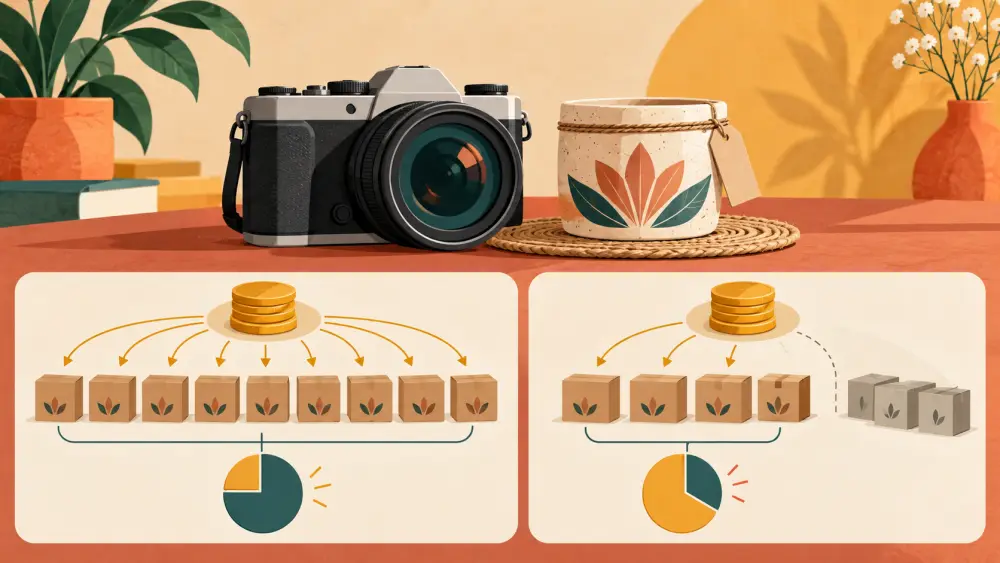
Photography and samples are real costs. You paid for a shoot, a model or props, and you made or bought sample pieces to get them right. Yet these costs are easy to leave out of the price because they do not feel like part of any one order. Leaving them out means the shop quietly earns less than your spreadsheet says.
Spread a one-time cost over many units
A one-time cost needs to be recovered over the units you expect to sell. Divide the cost by the expected number of units, and add the result to each unit's cost.
Say you spend Rs 3,000 on a photo shoot for a new product, and you expect to sell 150 units of it before you change the design.
- Rs 3,000 divided by 150 is Rs 20 per unit.
So each unit carries Rs 20 of photography cost, in addition to making and packing.
The effect on margin
Say the product sells for Rs 400 and its making and delivery cost is Rs 240, leaving Rs 160 profit before photography, which is a 40 percent margin.
- After adding Rs 20, profit is Rs 140. Margin is Rs 140 divided by Rs 400, which is 35 percent.
Five points of margin disappeared because of a shoot you did once. It would have been invisible if you had left it out.
What if fewer units sell
Be careful with the expected sales figure. It is a guess, and a shoot is spent upfront. If only 100 units sell, the cost per unit is:
- Rs 3,000 divided by 100 is Rs 30.
Profit per unit falls to Rs 130, which is a margin of 32.5 percent. With 100 units sold you earned back the shoot at Rs 30 a unit, but your margin was lower than you planned.
If you set your price assuming 150 and only 100 sell, you end up short. A cautious approach is to pick a lower number of expected units, or to treat the shoot as marketing and not charge it to one product.
Sample costs work the same way
Include sample pieces you made or bought, which you cannot sell or can only sell at a discount. Add the sample cost to the shoot and divide the total by expected units. Do the same for materials you wasted while developing the product. See raw-material-wastage-in-costing for the wastage side.
When not to charge it per product
Spreading cost is right when a shoot is for one product. Often it is not. A shoot that covers your whole range, a brand banner or a lifestyle set used across many products is better treated as overhead, shared across all orders. overhead-per-order-allocation shows how to do that. You can also reduce the cost with a batch approach, such as in batch-shoot-a-whole-catalogue-in-one-day.
Keep it light
You do not need a precise figure for every shoot. A good rule is:
- Write down what you spent on photos and samples for the product.
- Estimate a realistic, slightly cautious number of units.
- Divide and add the result to the cost per unit.
- Check the margin and decide if the price still works.
If it does not, you have three choices: raise the price, spend less on the next shoot, or accept a lower margin on this product for the sake of the range. All three are fine, as long as you make the choice knowingly.