
Packing sarees and ethnic wear without creases or stains
How to fold, wrap and seal sarees, lehengas and kurta sets so they reach a customer looking cared for, with realistic expectations about creases.
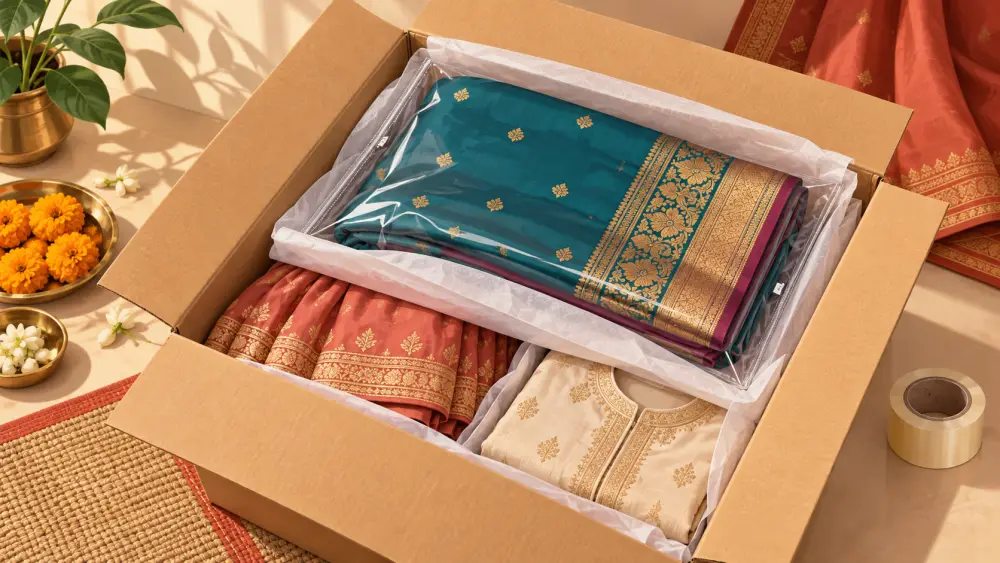
A saree is not a t-shirt. It is long, delicate and often expensive to the person buying it, and many are bought for a wedding or a festival with a date attached. That makes packing a place where small habits matter.
Know what you are protecting
Different fabrics need different care. Silk and zari borders can snag. Cotton picks up dust quickly. Chiffon and georgette slip and crumple. Embroidered kurta sets can catch on rough surfaces. Before you pick a fold, look at what is most fragile on the piece, usually the border, the embellishment or the print, and fold so that part sits protected inside.
A saree fold that works
Most sellers fold sarees in pleats, the same way a shop would present them.
- Lay the saree flat and open, with the pallu on one end.
- Bring the borders together to meet along the middle, so the decorative edges are inside.
- Fold the long strip in half, then in quarters, until it makes a neat rectangle.
- Keep the pallu design facing up if you want it to be the first thing the customer sees on opening.
Avoid folding exactly along the same lines each time you restock, because repeated creases leave permanent marks. If a saree has been stored folded for a while, steam or press it lightly before packing.
Tissue is your friend
Place acid-free or plain tissue paper between the folds, especially across embroidery, sequins or heavy borders. It prevents metal threads from scratching other layers and keeps colours from rubbing on to each other. For dark and light pieces in one parcel, always wrap them separately.
For a lehenga or a heavy anarkali, put tissue inside the folds and roll the fabric loosely around a cardboard tube if you have a long shipping time, because tight folds on heavy fabric can crush the shape of the pleats.
Inner bag, then outer cover
Slide the folded saree into a clean polybag and seal it fully. This keeps moisture and dust out. Then place that bag inside a sturdy outer cover, a stiff mailer or a thin carton.
- Use a stiff outer cover for sarees with heavy borders so the border does not bend.
- Keep sealing tape away from the garment layer; tape should only touch the outer cover.
- Never use staples that can pass through to the garment.
Think about stains before they happen
Stains in transit usually come from three things: ink from the label, oil from your own hands, and moisture. Write the address on the outer cover or on a sticker, never on the inner bag. Wash hands before folding. Keep the packing area away from food and sprays.
If you sell both bright and delicate colours, a lighter polybag that does not leak dye and a fully opaque outer cover add a safety layer that costs very little.
Be honest about creases
Folded fabric will carry folds. Silk and cotton in particular remember creases, and no packaging can promise a crease-free arrival. Say this plainly on your product page: tell customers the piece is folded for shipping and may need light pressing or steaming on arrival. A line like that sets expectations and reduces complaints.
You can also include a small care card with ironing or dry-cleaning notes. If you want help writing one, see how to write care instructions for your products.
Add a record for yourself
Photograph the saree before and after folding, with a visible order slip, just before sealing. If a customer later says it arrived stained, you will have a calm, factual starting point for the conversation. Our post on the cost of a damaged-in-transit parcel explains why that small habit protects your margins.
For more on delicate fabric, see packing embroidery for courier safely.