
How to pack brass and pooja items so they reach the customer safely
Heavy brass diyas, lamps and idols dent and scratch in transit, so here is a layer-by-layer packing method that protects the metal and the finish.
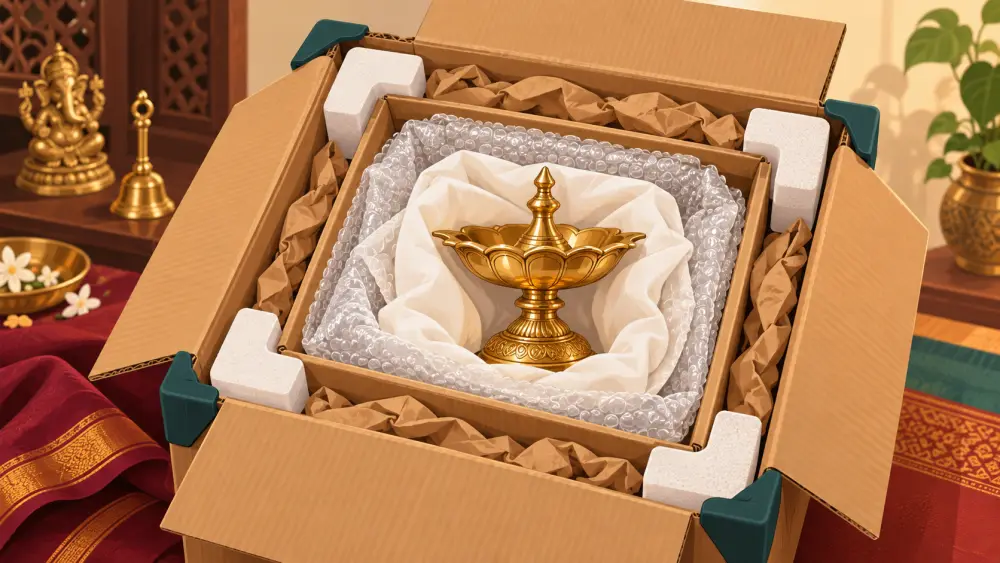
Brass and pooja items have a particular problem: they are heavy and often have fine details. A brass lamp that arrives dented, or an idol with scratched polish, ruins an occasion for the buyer and costs you a replacement. The fix is not expensive materials but a careful method. Here is one you can use at home.
Understand how brass gets damaged
Think about what happens in a courier network. Parcels are thrown into bags, stacked, dropped and squeezed. Heavy brass does three things in that situation: it moves inside the box and hits the walls, it rubs against other items and scratches, and its weight crushes anything fragile beneath it. Your packing has to stop the movement, protect the surface and keep a gap between the metal and the outer box.
Step 1: Protect the surface first
Before any cushioning, wrap the item in a soft layer that will not scratch or leave marks. Thin tissue paper or a soft cloth works well. If your brass has a lacquer or a polished finish, avoid plain newspaper directly against it, since print can rub off. Wrap hanging parts, such as chains or bells, separately so they cannot swing and hit the body.
Step 2: Add a cushioning layer
Cover the wrapped item in bubble wrap. Use more layers around the points that stick out: the rim of a diya, the top of a lamp, the base of an idol. Tape the wrap closed so it does not unravel. Do not rely on a single thin layer for something heavy.
Step 3: Fill hollow parts
Many pooja items have hollows: bowls, lamp cups, kalash openings. Fill the hollow gently with crumpled paper so the walls are supported from inside. Never put a hard item inside another item, because the two will hit each other.
Step 4: Choose the right box
Use a strong corrugated box that is only slightly bigger than the wrapped item. A box that is too big lets the item move, and one that is too small squeezes the bubble wrap. Brass needs a sturdy box because the weight pushes against the walls. Reuse boxes only if they are not soft or damp.
Leave about a thumb's width of cushioning around the item on every side, including the bottom and top. Fill the gaps with crumpled paper or more bubble wrap until nothing shifts when you shake the closed box gently.
Step 5: Pack multiple items separately
If an order has a lamp, a plate and a bell, wrap each one individually and place cushioning between them. Put the heaviest piece at the bottom and the lighter items on top. Never let metal touch metal.
Step 6: Seal and label
Seal every seam with strong packing tape, including the edges. Add a "Fragile" and "This side up" label, though remember that couriers may not always follow them, so your packing must do the real work. Put a slip with your contact details and the order number inside the box too.
Step 7: Take a photo before shipping
Photograph the item wrapped and the closed box. If a buyer reports damage, this record helps you in a claim with the courier. For more on keeping orders safe, read shipping across India: what small brands should know.
Check weight and a test run
Weigh the packed box and enter the real weight when you book the courier, since underdeclaring can cause extra charges later. Before you ship a new product type, pack one, then drop it from waist height onto the floor. If it survives without damage inside, your method is working. If not, add more cushioning and test again.
Show the buyer your care
A small note that says the item was hand-packed and polished before sending is a warm touch. For how to describe the finish honestly in the first place, see photographing brass lamps for your online store.