
How to pack art prints and posters without folds or dents
Tubes, rigid flat mailers and corner protection, explained for sellers who ship prints and posters and want fewer damaged corners and creases.
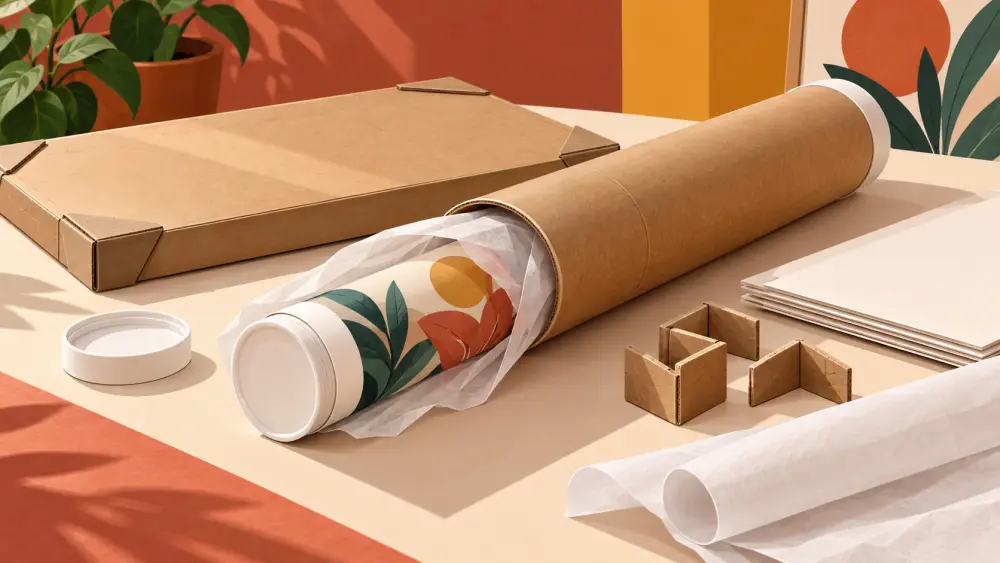
A print that arrives creased or with a dented corner is hard to sell again and hard to defend. Customers buy art because they want to hang it, and a crease across a design can ruin that. The good news is that the packing options are simple and cheap.
Two main ways to pack
You will mostly choose between rolling the print into a tube or keeping it flat in a rigid pack.
Tubes
Tubes are good for larger posters and for prints that can be rolled without cracking.
- Roll the print with the image facing outward or inward depending on the paper; test with a spare copy to see which has less curl at the ends.
- Wrap the print in tissue or glassine first, then slide it into a sturdy cardboard tube.
- Cap both ends firmly and tape the caps so they cannot pop off.
- Fill any extra space inside with crumpled paper so the roll cannot slide.
Tubes protect from sharp creases, but they can still be squashed or bent in rough handling. Do not promise a customer that a carrier will keep a tube straight.
Rigid flat packs
Flat packs suit smaller prints, cards, or anything that should not be rolled, such as thick board or textured paper.
- Place the print in a clear sleeve or bag with a backing board.
- Sandwich it between two sheets of stiff cardboard that are slightly larger than the print.
- Tape the cardboard sandwich closed on the edges, not on the print.
- Put the pack in a mailer marked "do not bend".
Protect the corners
Corners take most of the impact. Add extra protection by:
- Slipping cardboard corner pieces over each corner inside the pack.
- Making sure the print does not touch the outer edges of the mailer.
- Using an outer pack that is not much bigger than the sandwich, so the print is not rattling about.
Use the right wrapping layer
Direct plastic on the print can trap moisture. Use a clear polybag only if it is sealed and the paper is fully dry. For delicate inks, put a sheet of tissue or glassine between the print and anything else. Never use tape directly on the artwork.
If you sell several prints in one order, interleave tissue between them and keep them in the same direction.
Test before you ship
Press gently along the pack. If it flexes easily, the cardboard is too thin or the pack too loose. Add another layer. Then give the closed pack a gentle shake to check the print is not sliding inside.
Label clearly
Write "Fragile - do not bend" on the outer pack and, if you use a tube, "do not crush". It will not always be followed, but it is a free reminder.
Be realistic with customers
You cannot promise a tube arrives straight or a flat pack arrives without any dent. What you can do is say how you pack, give customers an easy way to send a photo if something is damaged, and explain your replacement or refund approach. The post on cancellations, refunds and restocking helps you shape that policy.
Count the cost
Tubes and rigid boards cost more than a plain polybag. Add that cost to your price so a damaged parcel does not wipe out the margin. See packaging cost per order, a breakdown for a way to add it up.
If you are thinking about selling prints for the first time, how to start selling art prints online in India covers listing and pricing, and how to photograph art prints and paintings flat will help your product images match what the customer receives.