
What Instagram content shows off bags and accessories well?
Bags and accessories raise questions about size, space and material. Four content types answer them honestly, from whats-in-my-bag to carry tests.
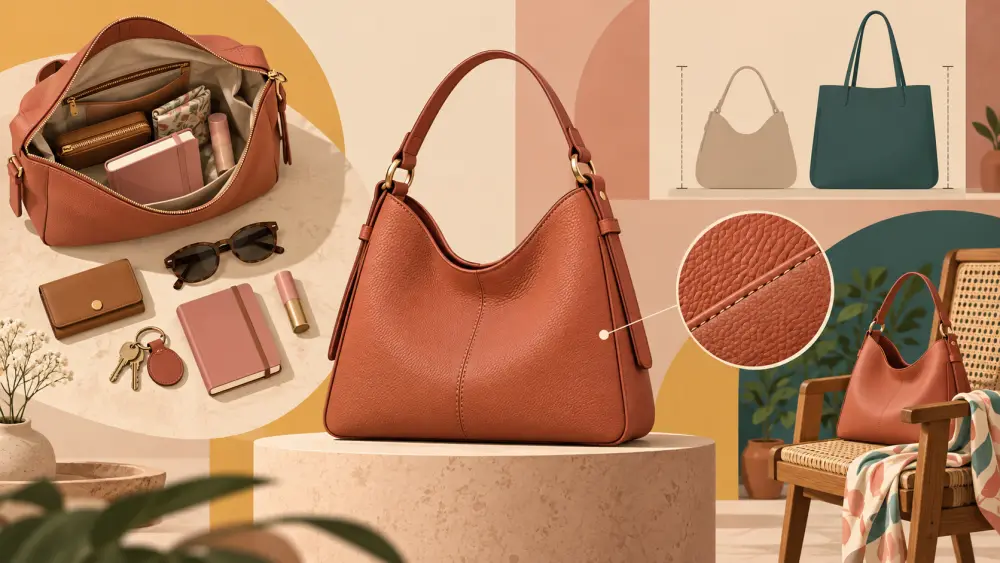
When someone looks at a bag online, three questions run in their head. How big is it, what fits inside, and what is it actually made of. Good Instagram content for bags and accessories answers those, and it does so without needing a studio.
Whats-in-my-bag
This is the classic format and it works because it answers the "what fits" question by showing instead of telling. Empty a bag onto a table, then put things back one by one. Use real everyday items such as a phone, a wallet, a water bottle, keys, a small notebook and a lipstick.
A few ways to make it clear:
- Say which items did not fit, if any. A laptop that does not go in is useful information, not a flaw to hide.
- Show the bag from the side at the end, packed, so people can see how it bulges.
- Mention the bag name in the first line so the clip is easy to link to the product.
Size comparison
Dimensions in centimetres are hard to picture. Show the bag next to something familiar, held at the shoulder, across the body, or on a chair. If you are short on options, stand next to a door frame or hold the bag against your torso.
Do read out the real measurements from the product, measured with a tape. Skip any number you have not taken yourself. The post on how to photograph products for scale gives more ways to show scale in a still photo.
Material close-ups
For bags, texture is the sell. Get close to the stitching, the zip, the lining, the handle attachment and the corners. Natural light from a window makes the grain visible. For ideas on shooting, how to photograph bags and wallets walks through angles.
Be exact in words. If the material is canvas, say canvas. If it is faux leather, say faux leather. Do not call something genuine leather or waterproof unless it is, and unless you have the paperwork from your supplier. A buyer who gets a rain-spotted bag after you called it waterproof will not come back. A softer line, such as "wipe with a damp cloth" if that is what your care instructions say, is safer.
Carry tests
A carry test shows how the bag behaves in real life. Walk with it on one shoulder, switch to cross-body, open and close the zip with one hand, and set it down on a table to see if it stands upright. These small moments answer questions people rarely type out.
Keep tests fair. Fill the bag with a reasonable load and avoid stunts that would never happen in daily use. If a strap digs in when the bag is heavy, you can mention the weight where it starts to feel uncomfortable, from your own trial.
Pair posts with a product page
All of this is much more useful when the clip leads to a listing that repeats the key facts: dimensions, material, colour, closure type and what you tested. Link your bio to your store, and consider embedding a short video on the product page. How to start selling bags online in India covers the basics of setting up the listing.
A weekly plan to try
You can rotate these four formats and keep a fifth slot free for customer photos shared with permission. Shoot all of them on the same afternoon with one bag at a time, because lighting and background then match across the week.
Start with a whats-in-my-bag clip for your best-selling bag. It takes ten minutes, needs no props beyond what is on your desk, and answers the question buyers ask most.