
How do I cost a food product that loses weight in making?
Cleaning, roasting and drying remove weight, so cost the finished kilo you sell, not the raw kilo you bought.
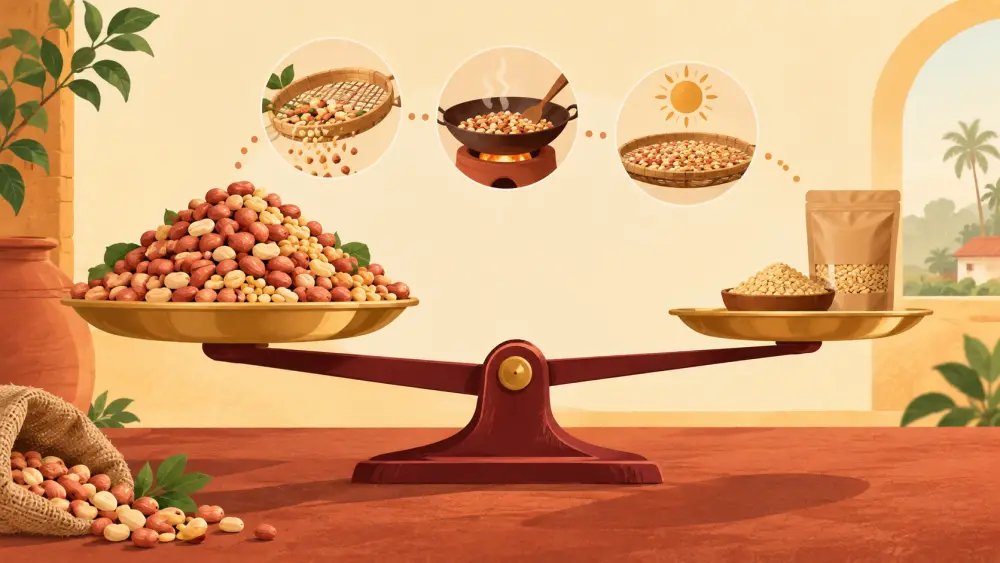
If you make snacks, spice blends, roasted nuts, podi or dried foods, the weight you buy is not the weight you sell. Cleaning removes stalks and stones. Roasting and drying drive out moisture. The product that goes into the pack is lighter than what came through your door, and your costing has to reflect that.
The yield idea
Yield is the share of your input that ends up as sellable product. Cost per finished kilo equals total ingredient cost divided by finished weight.
Imagine you buy 5 kg of raw material for Rs 1,000. That is Rs 200 a kg. After cleaning and roasting, you end up with 4 kg.
Rs 1,000 divided by 4 kg is Rs 250 a kg.
The real cost of your finished product is Rs 250 a kg, not Rs 200. One kilo of weight vanished, but its cost did not.
Why it matters for pricing
If you price a 250 g pack using Rs 200 a kg, the ingredient cost looks like Rs 50. At the true Rs 250 a kg it is Rs 62.50. That is Rs 12.50 per pack you have not accounted for.
Over a batch of 100 packs of 250 g, which is 25 kg of finished product, the missed cost is Rs 1,250. It may be the difference between a small profit and a small loss.
Measure your own yield
The numbers above are examples. Your yield depends on the ingredient, its quality, the season, how long you roast, and how carefully you clean. Measure instead of assuming.
- Weigh the raw ingredient.
- Process it exactly as you normally do.
- Weigh what you will actually pack.
- Divide finished weight by raw weight. In the example, 4 divided by 5 is 0.8, or 80 percent yield.
Do this for two or three batches and take an average. Weigh again at different times of year if the raw material changes, because moisture content shifts with the season.
Multi-ingredient products
For a blend, work out the yield for the whole batch. Add up the cost of all ingredients, then weigh the finished mix. Divide the total cost by the finished weight. Then add the other costs, such as fuel, packaging and labels.
Other food-specific costs to remember
- Packaging that touches the product, such as pouches, jars, seals and labels.
- Fuel or electricity for roasting and drying.
- Samples you give away and batches that fail.
- Any stock that goes out of date before it sells. For food, spoilage is a real cost.
- Rules for labelling and licences. They differ by product and place, so confirm with the relevant authority or a qualified adviser, and do not rely on guesses.
Pull it together
Once you know the cost of the finished product, pick the price you need for your margin using price from a target margin. For a full view of unit cost across batches, see batch production cost per unit. And if you are just beginning, how to start selling homemade food online in India covers the wider picture.
Yield is a number you can improve too. Better sorting, controlled heat and proper storage can all raise it, and each percentage point goes straight back into your margin.