
How to avoid exaggerated claims in your product descriptions
Why specific, checkable wording works better than superlatives, and how to rewrite common big claims into honest, useful sentences.
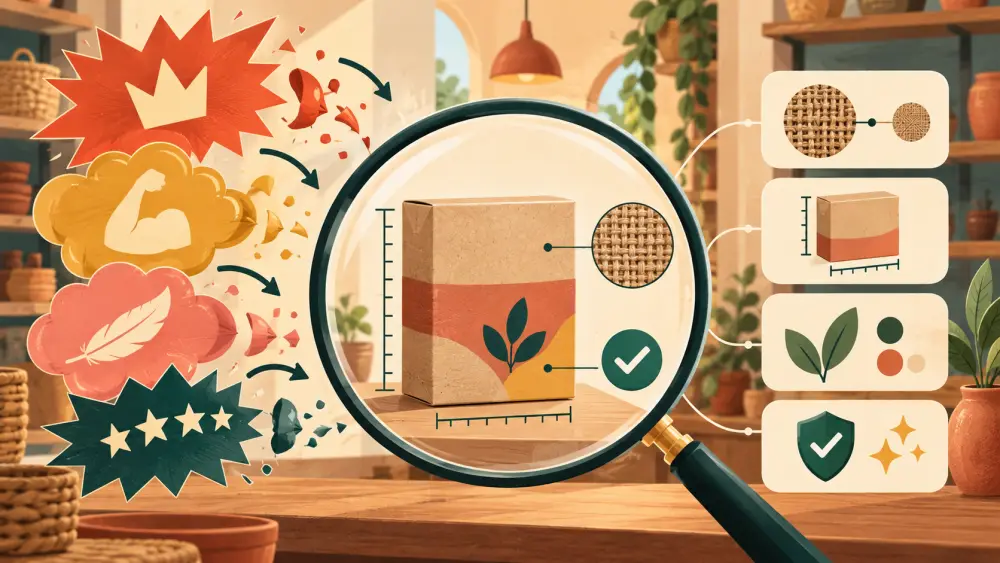
"Best quality in India." "Guaranteed results." "Never fades." Phrases like these are everywhere, and they are tempting because they sound confident. But a claim a customer cannot check, and you cannot prove, does more harm than good. It makes the page sound like every other page, and if it turns out untrue, it creates complaints.
Why specific beats superlative
A superlative ("the softest", "the best") asks the reader to trust you without evidence. A specific, checkable statement gives them something to judge for themselves. Compare:
- "The softest cotton you will ever wear" versus "Combed cotton, brushed on the inside".
- "Long lasting fragrance" versus "Scented with lavender essential oil; throw varies by room size".
- "Perfect for everyone" versus "Cut straight, runs true to size; see measurements below".
The second version in each pair gives the shopper something concrete. It also shows you know your own product.
Turn each big claim into a fact
Take a claim from your current listing and ask three questions:
- Can I show or measure this?
- Have I tested it myself?
- Would a customer be able to tell if it were false?
If the answer to any is no, rewrite the line. Replace "premium" with the material, "durable" with how it is made, "long lasting" with how long you tested it for, and say honestly what you did.
Be careful with certain words
Some claims can have legal or regulatory weight, particularly for food, skincare, health and anything described as natural, organic, pure or certified. I cannot give legal advice here, and the rules differ by product and change over time. Before using a claim like these, check with a professional or the relevant official source. If you cannot back it up, leave it out.
Do not copy claims from suppliers
Supplier descriptions are often written to sell, not to be accurate for your exact batch. If a supplier says "waterproof", test it before repeating it. See why copying supplier descriptions hurts your store.
Honest limits are a strength
Saying what a product is not good for is a quiet way to be believable. "Not suitable for machine washing." "Scent is light, not strong." "Hand painted, so no two pieces are identical." Shoppers who know the limits are less likely to be upset later, and your store builds a reputation for being straight with people, much like the approach described in building trust without a big marketing budget.
A quick rewrite exercise
Pick three claims on your site, and for each:
- Write down the evidence you have.
- Rewrite using only that evidence.
- If you have none, remove the claim.
You will probably end up with shorter, clearer descriptions that read more like a person talking.
Where to edit
In the Varchas product editor, the description field is where all of this lives, and you can change it any time without affecting the rest of the product. For the wider shape of a good description, read writing product descriptions people read.