
Why selling in Instagram DMs stops working
DMs are a great way to start selling, but the same habits that got you your first ten orders will slow down your next hundred.
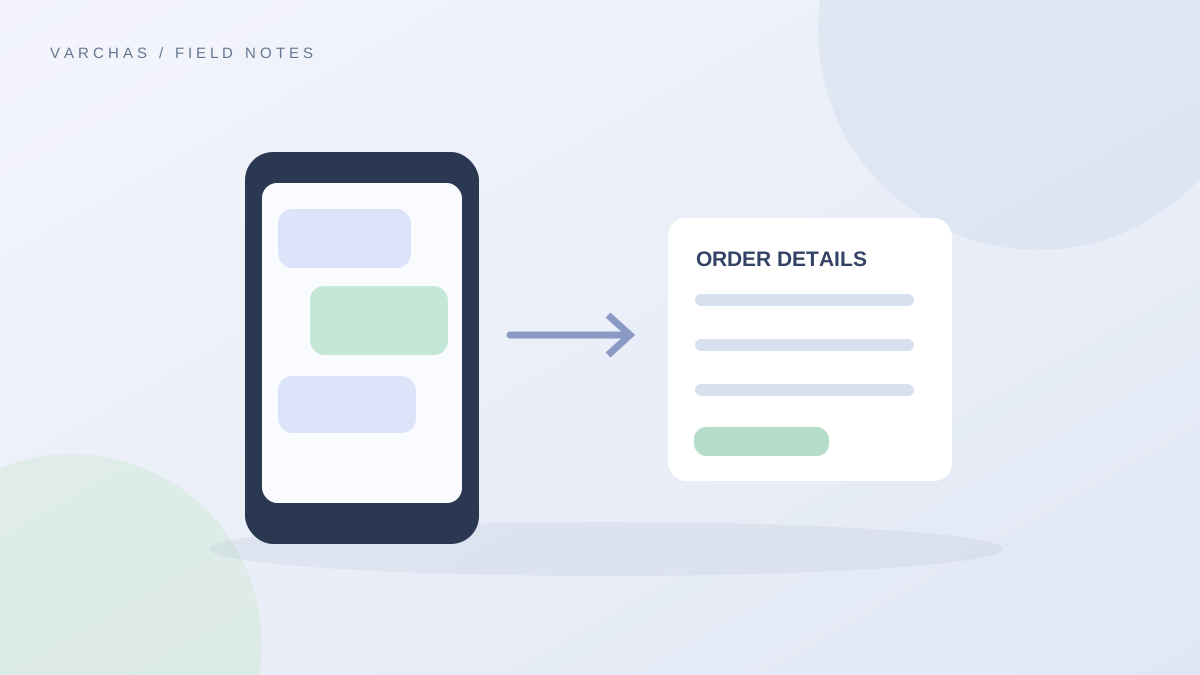
Every small brand starts somewhere, and for most Indian founders that somewhere is the Instagram DM. Someone comments on a saree post, you slide into their DMs, you send photos, you agree on a price, you share a UPI ID, you note the address by hand. It works. It feels personal. And for the first ten or twenty orders, it is genuinely the fastest way to sell.
The trouble is that DMs do not scale the way a business needs to. What feels like personal attention at ten orders a day becomes an unmanageable inbox at fifty. You are not being lazy or disorganised when this happens - you are simply running into the limits of a tool that was built for conversation, not commerce.
The math stops working quietly
At low volumes, you can hold every order in your head or in a notebook. You remember that the blue kurta went to the customer in Indore and the payment for the earrings is still pending. As orders grow, this memory system breaks down without any single dramatic moment - it just gets a little worse every week. A payment gets missed. A size gets confused. A repeat customer messages "I ordered from you in March" and you have no easy way to check.
This is not a discipline problem. It is what happens when a manual system meets growing volume. The DM thread was never meant to be an order ledger, a payment record and a shipping address book at once.
Every new customer starts from zero
In a DM-only setup, each conversation is its own island. A customer who bought from you in January has no account, no order history, nothing that ties them to your brand except your memory of them. If you want to tell every past customer about a new collection, you have to scroll back through months of chats to even find them.
Compare that to a proper store, even a simple one. A customer's past orders sit against their name. You can see who bought what, when, and reach out to exactly those people when something new arrives. That single change - having a record instead of a memory - is often the difference between a brand that grows and one that keeps meeting the same customers as if for the first time.
Trust has a ceiling in a DM
A new customer discovering your brand through a comment or a friend's story has to decide, in a few seconds, whether to hand over money to a stranger's UPI ID with no receipt, no order confirmation and no real proof of a business behind it. Many will. Many more, especially first-time buyers who don't know your brand yet, will hesitate and scroll on.
This is not about DMs being unsafe. It is about what a DM signals. A conversation looks like a person selling casually. A store, even a small one with your own name and photos, looks like a business that intends to stay around, which matters more than founders often expect. We wrote more on this in what a website says before anyone buys.
Your best customers deserve less friction
The customers most worth keeping are the ones who already trust you and want to buy again quickly. Making them type out their address for the third time, or wait for you to reply between other conversations, wastes the goodwill they have built with your brand. A returning customer should be your easiest sale, not your slowest one.
What to actually do about it
None of this means abandoning DMs. They remain a good place to answer questions, show new arrivals, and build the relationship that makes someone want to buy from you at all. The shift worth making is in where the actual transaction happens.
- Keep using DMs for conversation, discovery and answering questions.
- Move the order itself - product selection, address, payment - to a place that keeps a record automatically.
- Let repeat customers skip the back-and-forth entirely.
A simple store that takes UPI and Cash on Delivery, set up alongside your existing Instagram presence, does exactly this without asking you to abandon what already works. If you want to see what that looks like for a brand your size, early access is a good place to start.