
Why a landmark and phone number in the address help delivery
In many Indian neighbourhoods house numbers are patchy, so a landmark and a reachable phone number do the real work of getting a parcel to the right door.
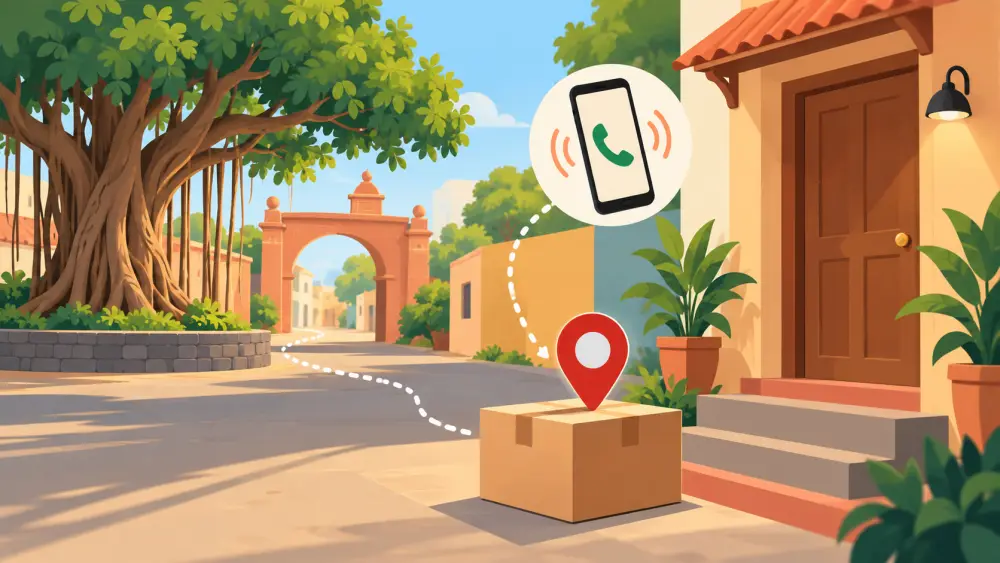
Anyone who has tried to give directions in India knows how it goes. "Take the lane after the temple, then left at the blue gate." Numbers on doors can be missing, repeated or out of order. Delivery staff deal with this every day, and a good landmark makes their work possible.
Why house numbers are not always enough
In planned layouts, numbers run in a neat order. In older areas, newer colonies and many villages, they do not. Houses may be numbered in the order they were built. Lanes may have several buildings with the same name. A map pin may be off by a street.
Because of this, delivery staff often rely on local clues, not just the written number.
What makes a useful landmark
A good landmark is one that a person standing in the street can spot easily.
- Something permanent, like a temple, school, bank branch, petrol pump or hospital.
- Something close to the house, not a famous place that is a few kilometres away.
- A description of position, such as "opposite the school gate" or "behind the community hall".
Avoid landmarks that may change, such as a shop that is about to move, or one that is vague, such as "near the main road".
Why a phone number is just as important
Even with a good landmark, the last hundred metres can be confusing. A working phone number lets the agent ask a quick question and be guided to the door.
- Use a number that the receiver actually carries, not a landline that rings at an empty house.
- If the customer is at work, ask whether another family member can be the contact.
- Mention if a number is WhatsApp only, because some people do not pick up unknown calls but check messages.
I cannot say how every courier handles calls, so check their process rather than assuming every agent will phone before delivery.
How to ask for it in a friendly way
Many customers skip the landmark simply because they know their own home too well. A short prompt in your form or message does the job.
- "Add a nearby landmark, like a school or temple, so the delivery person can find you."
- "Please share a phone number that will be answered during the day."
Customers usually respond well when they see the reason.
How to spot a weak address
A strong address has a landmark and a phone. A weak one looks like this.
- A name and an area only.
- A landmark that is too general, such as "near the market".
- No phone number, or one with a missing digit.
If you see this, ask before booking. Our post on how to verify a customer address before you dispatch gives a simple routine.
What it will not do
A landmark and phone number make delivery easier, but they cannot guarantee it. A customer may still miss the call or be away. Treat them as helpful details, not promises.
Pair it with a good structure
Landmarks work best as part of a complete address, with flat, building, street, area, city and pincode. See what a clear delivery address looks like for the full layout. For the wider picture of how addresses affect your costs, read returns and RTO, the numbers nobody tells you.