
Should I use a WhatsApp catalogue or my own store link?
A chat catalogue is quick to start, while your own store gives you more control over orders, payments and customer data, and most sellers end up using both for different jobs.
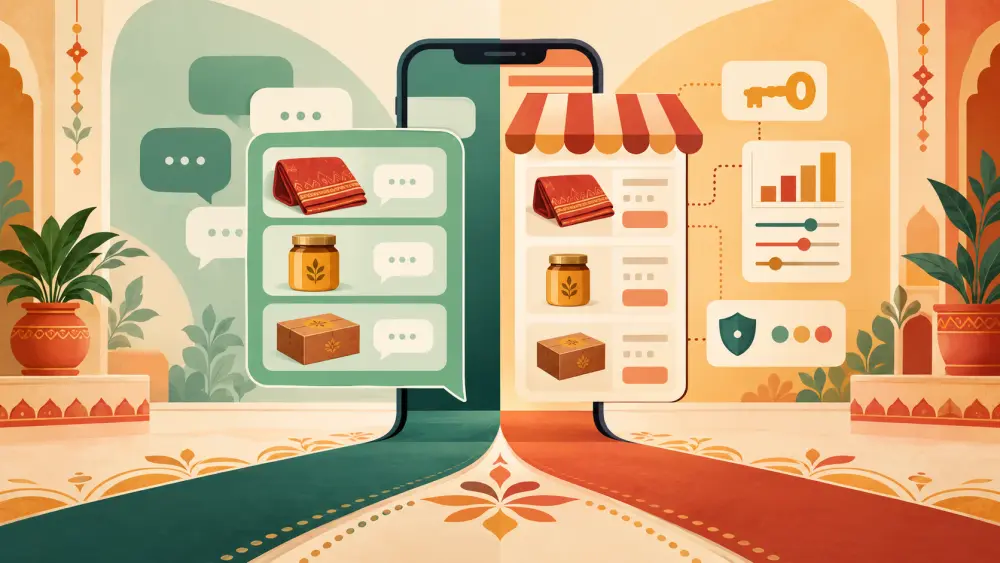
The honest short answer
Use whichever lets you start selling this week, and plan to own a store link as you grow. They are not enemies. A chat catalogue is a convenient window. Your own store is the shop behind it.
The right choice depends on what you need to control. Let us go through it by the things that matter to a small seller.
Setup effort
A chat catalogue is the lowest-effort start. You add photos, names and prices inside the app you already use, and share it in a conversation. If you have ten products and a handful of regular buyers, that may be all you need today.
A store takes longer to set up, since you add products, set shipping and connect payments. Think of it as a one-time job. Our guide on setting up your online store in a week shows a realistic pace.
Control over the rules
In a chat catalogue, the app decides how items are shown, what fields you get and how many options you can add. Those rules can change, and you do not decide when. Check the current limits yourself rather than relying on what someone told you last year.
On your own store, you decide the layout, variants, policy pages and checkout. If you want size options, a return policy page or a free-shipping rule, you can set it. Nobody else changes it overnight.
Orders and payments
With a catalogue, orders still end up as messages. You read the message, work out the total, send payment details, wait, confirm. It works, but each step is manual and each is a chance for a mistake. Our post on WhatsApp orders being great until they are not covers where that breaks.
With your own store, a customer picks items, enters the address and pays or chooses cash on delivery in one flow. You get a clean order record instead of a chat to decode.
Your customer data
Customers who order through a store leave you their name, phone and address in your own records. You can export that and contact them for their next order. Customers who only ever exist inside a chat live on the platform and your phone. If the phone is lost or the number is blocked, the relationship is hard to rebuild. More on this in keeping your customer data yours.
Tracking and after-sales
A store link lets you send a tracking page so customers can check status themselves, which cuts the "where is my order" messages. In a pure chat flow, you paste tracking details by hand each time.
Discovery
A catalogue helps people who already have your number. A store link can go into your Instagram bio, your packaging and your visiting card, so people who have never chatted with you can still browse. You can do both. Put the store link in your chat replies and let the chat be for questions.
A simple way to combine them
- Keep chat for talking, quick questions and personal recommendations.
- Send the store link when someone is ready to buy.
- Use the catalogue only as a quick preview for people who ask "what do you have".
- Save the order record and customer details in your own store.
When a catalogue alone is fine
If you sell a few items to people you know, take orders rarely and never ship outside your city, a chat catalogue may be enough for now. Revisit the choice when you notice you are retyping the same totals, chasing payments or losing track of who ordered what.
When to move to your own store
Move when handling orders by hand starts to cost you more time than selling. That point comes sooner than most people expect, usually when you pass a few orders a day. Start the store before you are drowning, not after.