
What is conversion rate? (and why it matters for your store)
Conversion rate is the share of store visitors who place an order, and with 200 visitors and 4 orders the arithmetic is simple enough to do on your phone.
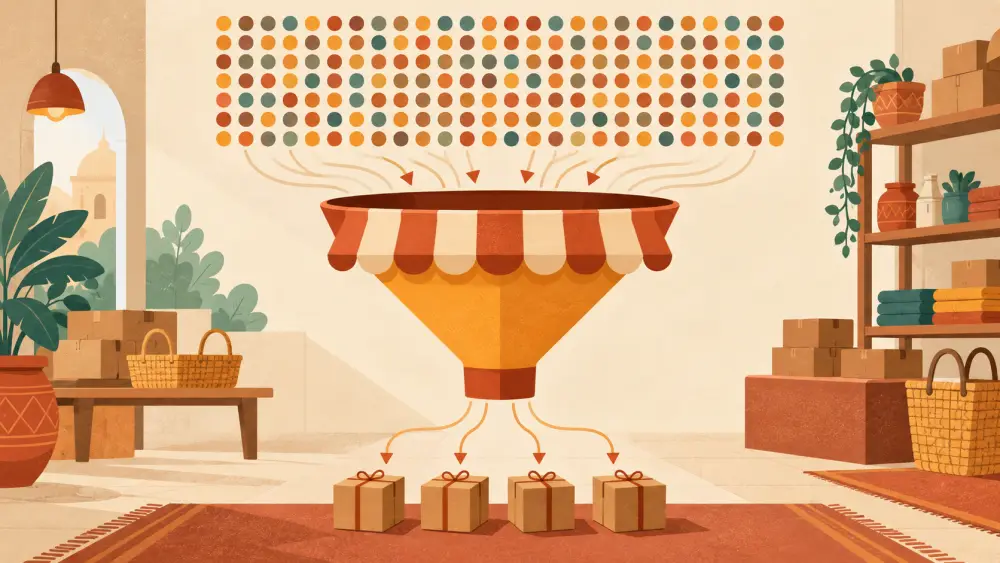
People throw around the phrase conversion rate as if it were a mystery. It is just a division sum. Understanding it tells you whether your problem is getting people to your store, or getting them to buy once they are there.
The meaning
Conversion rate is the percentage of visitors who do what you wanted, which for a store is usually placing an order. The formula:
orders divided by visitors, multiplied by 100.
A worked example
Say your store had 200 visitors last month and 4 of them placed orders. These are illustrative numbers.
4 divided by 200 is 0.02. Multiply by 100 and you get 2 percent.
So your conversion rate was 2 percent. In everyday words: out of every 100 visitors, about 2 bought.
Notice what the figure does not tell you. It does not say whether 2 percent is good or bad. Different products, prices, traffic sources and seasons give very different results, so please do not compare yourself to numbers you read somewhere. Compare with your own past months.
Why it matters
Imagine two months. In month one you have 200 visitors and 4 orders. In month two you have 400 visitors but still 4 orders. Your visitors doubled, your orders did not move, and your conversion rate fell from 2 percent to 1 percent. That tells you the extra visitors were less interested, or something on the store put them off. Without the rate, you might celebrate the visitor count and miss the issue.
It also helps you plan. If you know about how many visitors turn into orders, you can see what more visitors might mean. Do this carefully, though, because it is not a promise. Extra visitors from a different source may behave differently.
Two sides of the problem
When orders are low, ask which side is weak:
- Not enough visitors. The fix is more visibility: posts, creators, search, word of mouth. See how to read your store traffic sources simply.
- Visitors but few orders. The fix is on the store: clearer photos, honest descriptions, simpler checkout, reassuring policies, fair shipping costs.
Things that commonly affect it
- Photos that do not show the product well.
- Unclear price or delivery cost until the last step.
- Slow pages on mobile networks.
- Too many choices.
- A checkout that asks for too much.
- A shopper who is simply browsing and not ready to buy. Some visits will never convert, and that is normal.
Writing product descriptions people read and what should your main product photo show are good places to start.
Measuring it
You need two numbers for the same period: visitors from an analytics tool, and orders from your admin. Connect analytics if you have not, using connecting Google Analytics to your store. Write both numbers monthly and divide.
With small numbers, results jump around. Four orders versus six may only be luck. Look at a few months together before concluding anything.
Use it as a question
Treat the rate as a prompt, not a score. If it falls, ask what changed that month: a new source, a price shift, a broken link. If it rises, ask what you did differently and try to repeat it. Change one thing at a time so you can see what made the difference.