
What is a UTM link and why would a small seller use one?
A UTM link is your normal store link with a few labels added at the end, so you can tell which post, creator or message sent a visitor to you.
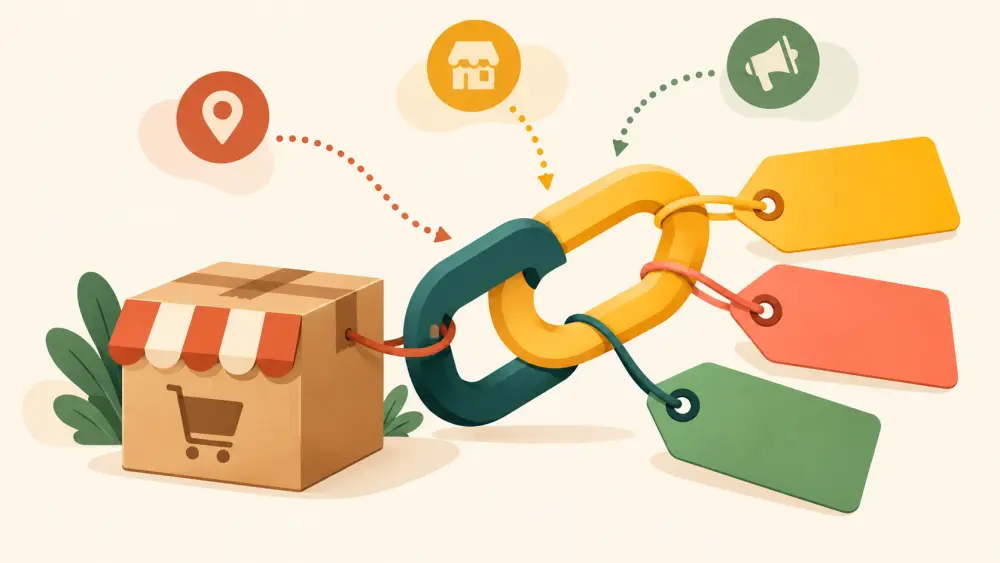
Imagine you share your store link in your Instagram bio, a WhatsApp broadcast, a creator's story and a reel caption. Visitors arrive. Which one worked? A normal link cannot tell you. A UTM link can, because it carries labels with it.
What UTM means
UTM stands for Urchin Tracking Module, a name from an old analytics tool. You do not need to remember it. Think of a UTM link as a normal web address with a small tag added to the end. When someone clicks it and lands on your store, analytics tools that read these tags can show where that visit came from.
The three tags that matter
There are more, but three cover almost everything:
- utm_source: where the link was placed. For example instagram, whatsapp or a creator's name.
- utm_medium: the type of channel. For example social, story, broadcast or email.
- utm_campaign: the specific push. For example diwali-launch or candle-reel.
Each is written as a name, an equals sign and a value, and they are joined with the ampersand symbol after a question mark.
An example
Say your store is at yourstore.in. A link for a reel about a new candle might look like this:
yourstore.in/?utm_source=instagram&utm_medium=reel&utm_campaign=lavender-candle
If someone clicks that, the visit can later be sorted under "instagram", "reel", "lavender-candle". A link for a WhatsApp broadcast about the same candle could use utm_source=whatsapp, utm_medium=broadcast and the same campaign. Now you can compare the two.
How to build one
You can simply type it by hand, as long as you follow the pattern. Keep the values lowercase, short, and without spaces. Use a hyphen between words. Choose names once and stick with them. If you write "insta" one week and "instagram" the next, your reports will treat them as different sources and become messy. A simple note listing your naming rules helps.
Many free link builders exist online where you fill in the three fields and copy the result. Pick one you trust and do not enter anything private.
Where it helps a small seller
- Telling which creator sent visitors, if you give each their own link. See how to track results from a creator collaboration.
- Comparing your bio link against a story link.
- Seeing whether a WhatsApp broadcast sent anyone to the store at all.
- Looking back at a month of campaigns, as described in reviewing your marketing at month end.
What it cannot do
A UTM link only records visits that came through that exact link. If someone sees your reel and later types your store name into Google, that visit is not credited to the reel. If a tool cuts the tag off a link when it shortens or redirects it, the label is lost. Some browsers and apps also strip parts of links. So treat the numbers as approximate.
Also, a UTM tag does nothing unless something reads it. You need an analytics tool connected to your store. If you use one, check in its reports that the tags are being picked up by clicking your own link once and looking for the visit. If you cannot see it, do not rely on the tags until you have sorted that out. Connecting Google Analytics to your store walks through the setup.
A habit worth building
Whenever you post a link anywhere, tag it. It costs about thirty seconds. Months later, you will have a trail of evidence instead of a guess about what is working.