
How do I make a simple monthly profit and loss statement?
List your month's revenue, subtract each cost in a fixed order, and read the leftover as your net profit, with a worked example that ends at Rs 12,000.
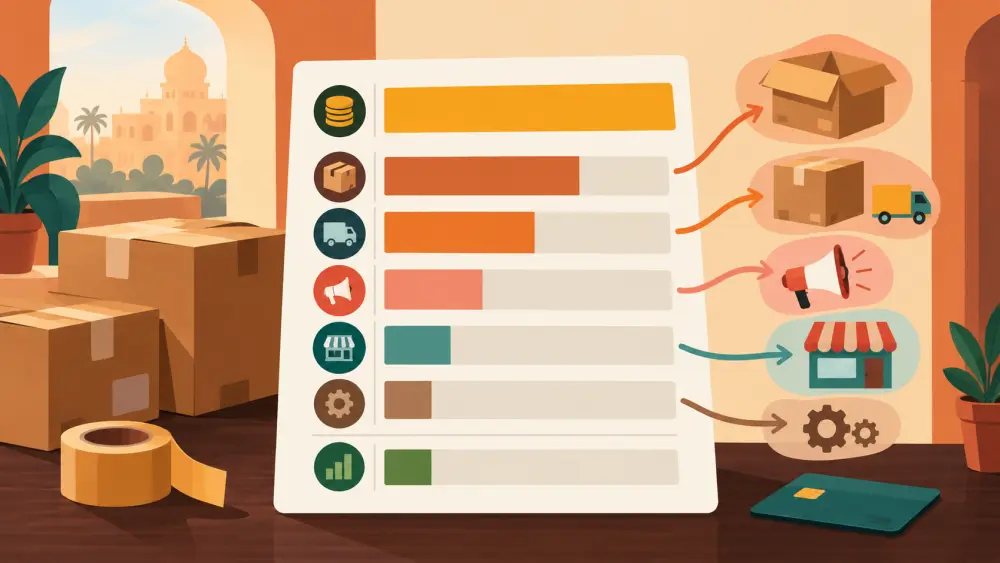
A profit and loss statement, often called a P and L, sounds like something for an accountant. For a small shop it is just one page that answers a plain question: after everything, did I make money this month? You can build it in half an hour with a notebook, a spreadsheet and your order list.
Step one, find your revenue
Revenue is the total value of orders you actually delivered and kept in the month. Use money received, after refunds and returns. Do not count orders you cancelled or got back.
In our example, revenue is Rs 1,20,000.
Step two, subtract costs in a fixed order
Always list the costs in the same order each month so you can compare months.
- Product cost, what you paid to make or buy what you sold: Rs 66,000.
- Shipping you paid couriers: Rs 9,000.
- Packing materials: Rs 3,600.
- Payment fees: Rs 2,400.
- Ads: Rs 15,000.
- Overheads, such as tools, phone bill, rent share and software: Rs 12,000.
Add them up: 66,000 plus 9,000 is 75,000. Add 3,600 for 78,600. Add 2,400 for 81,000. Add 15,000 for 96,000. Add 12,000 for 1,08,000.
Total costs are Rs 1,08,000.
Step three, read the result
Revenue Rs 1,20,000 minus costs Rs 1,08,000 leaves Rs 12,000. That is your net profit for the month.
As a share of revenue, Rs 12,000 divided by Rs 1,20,000 is 10 percent. So you kept ten paise of every rupee sold.
Two useful lines in the middle
Pause after product cost. Rs 1,20,000 minus Rs 66,000 leaves Rs 54,000, which is 45 percent of revenue. This is your gross profit. It tells you how healthy your products are before running costs.
Pause again after shipping, packing and payment fees. Rs 54,000 minus Rs 15,000 leaves Rs 39,000. This is close to your contribution. Ads and overheads then come out of it.
Looking at these middle lines tells you where a bad month came from. If the gross profit share drops, the problem is price or product cost. If the end result drops while gross profit holds, ads or overheads grew.
Things sellers forget
- Returns and refunds. If you paid money back, take it out of revenue.
- Your own pay. If you do not pay yourself, the statement flatters the shop. See owner-pay-vs-business-profit-split.
- Stock you bought but did not sell. Do not count stock bought as a cost. Count only the cost of what you sold. inventory-turnover-for-small-store is helpful here.
- Small recurring costs, such as domain renewals and app subscriptions. Put them under overheads.
Keep it simple
You do not need accounting software on day one. A sheet with one column for each month and one row for each line above is enough. Fill it in within the first week of the next month while you can still remember what things were.
For tax filing and GST treatment, this statement is not a replacement for your accountant's books. Ask your CA what they need from you, and share this sheet as a starting point.
Use it to decide
Each month, look at three things: the net margin, the gross profit share, and the biggest cost line. Change one of them next month, then see what happens. To understand how many orders you need just to cover your running costs, read break-even-units-for-monthly-fixed-costs.