
How much profit is left after a 10 percent coupon?
A single order walked line by line shows how a 10 percent coupon removes far more than 10 percent of your profit.
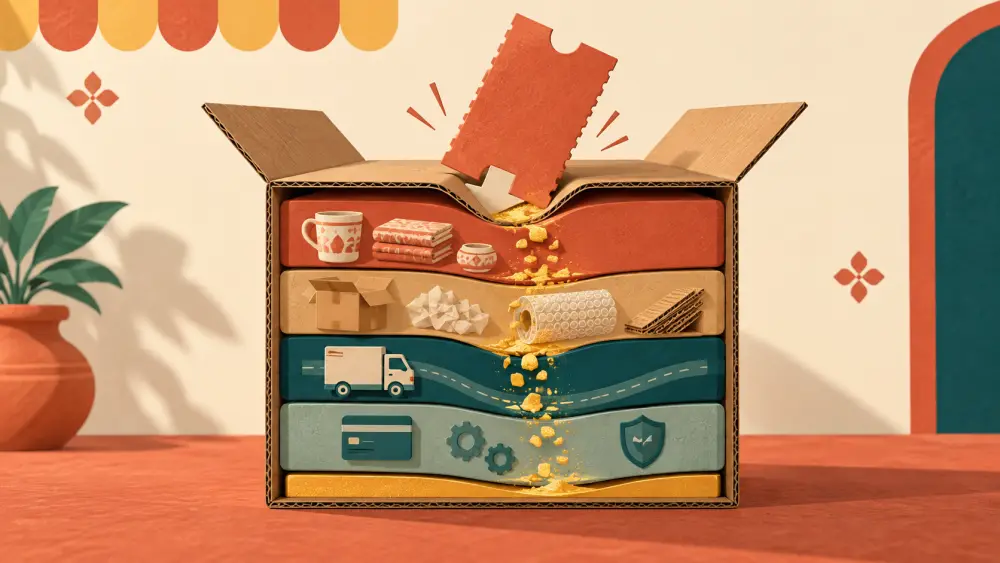
A 10 percent coupon sounds mild. Customers like it and it feels like a small thank-you. But your profit is a thin slice of the selling price, so taking ten percent off the price can remove a much larger share of the profit. Let us follow one order from start to finish.
The order before any coupon
Take an Rs 800 order with these illustrative costs.
- Product cost: Rs 480
- Shipping: Rs 70
- Packing: Rs 30
- Payment fee: Rs 16
Add them: 480 plus 70 plus 30 plus 16 is Rs 596.
Profit: Rs 800 minus Rs 596, which is Rs 204. That is 25.5 percent of the order value.
The coupon arrives
A 10 percent coupon takes Rs 80 off the Rs 800. The customer pays Rs 720, but you pay all the same costs. Profit becomes Rs 204 minus Rs 80, which is Rs 124.
In reality the payment fee may shrink slightly on a smaller amount, but I am keeping it the same for a clean comparison. Your actual fee depends on your payment provider.
What the coupon really took
The coupon took Rs 80 out of Rs 204. That is about 39.2 percent of your profit, from a coupon labelled 10 percent. Your margin dropped from 25.5 percent of Rs 800 to 17.2 percent of Rs 720, since 124 divided by 720 is about 17.2 percent.
Think of it this way. Your costs are fixed. Every rupee of discount comes straight from profit, and profit was never 100 percent of the price.
When this still makes sense
A coupon can be a good idea if it does one of these:
- Brings a customer who would not have bought at all, so Rs 124 beats zero.
- Clears stock you would otherwise write off.
- Starts a relationship that leads to repeat orders. See why the repeat customer is the whole business.
It is a poor idea when most of the people using it would have bought anyway. Then you simply gave away Rs 80 each. Our post on coupons that actually move stock covers how to aim them.
Check how coupons work in your store
In a Varchas store, a coupon in the admin has a code, a type (percentage or a flat rupee amount), an optional usage limit and an optional expiry date. Use the usage limit and expiry to cap the damage. Set a limit of, say, 50 uses and you know the most this coupon can cost you.
Do the sum before you launch
Before publishing a code, follow your own order through this list:
- Write the selling price.
- Subtract every cost, including shipping, packing and payment fee.
- Subtract the coupon.
- See what is left and whether you are happy with it.
If the answer is uncomfortably small, shrink the coupon, require a larger basket or attach it to a product with room in its margin. The next post on coupon minimum order values shows how to pick that basket size.
Know your starting margin
All this hangs on knowing your real margin first. If you are unsure, read pricing from a target margin.
Bottom line
A 10 percent coupon on an Rs 800 order cut profit from Rs 204 to Rs 124, a drop of nearly 40 percent. Run the arithmetic on your own order, and you can decide with open eyes.