
What does it cost me to keep stock sitting on the shelf?
Stock that does not sell is not free to keep, so put a monthly percentage on it and watch the rupees add up.
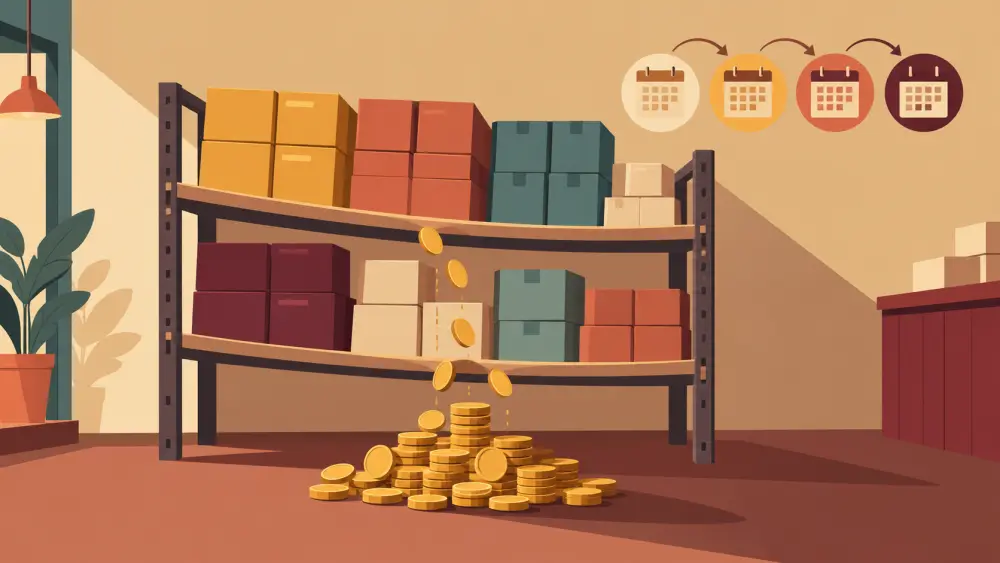
Many sellers see unsold stock as a pile of things they own. It feels safe because you can touch it. But every month it sits there, it quietly costs you money. Giving that cost a number makes it much easier to act on.
What goes into holding cost
Holding cost is everything you lose by keeping stock instead of selling it. It usually includes:
- Tied-up cash. The money you paid for the stock cannot be used for anything else.
- Space. Rent or the room in your home you give up for shelves and boxes.
- Loss and damage. Items get dusty, crushed, faded, chewed by pests or forgotten.
- Going out of date. Seasonal items, trend items and anything with an expiry lose value with time.
- Handling. The time you spend counting, moving and re-packing.
Not every item has all five, but most have two or three.
A simple way to price it
Pick a monthly percentage of the stock value. It is an estimate, not a law of nature. Your number could be lower or higher.
Suppose your stock is worth Rs 50,000 at cost. You assume a holding cost of 2 percent a month.
Two percent of Rs 50,000 is Rs 1,000 a month.
Over six months it is Rs 6,000. That is the price of keeping the same stock unsold for half a year, with no sale, no profit and no new customer.
Why Rs 6,000 matters
Compare Rs 6,000 with your usual profit. If an average order earns you Rs 200, then Rs 6,000 is the profit from 30 orders. A stock pile that sat for six months consumed the profit of 30 orders without anyone noticing.
You can also see it per item. If you have 100 units sitting in Rs 50,000 of stock, that is about Rs 500 per unit of value, and Rs 10 per unit per month at 2 percent. If an item sells for a profit of Rs 80, then eight months on the shelf takes all of it.
How to use the number
- List your products with the number of units and the cost value of each.
- Mark which ones have not sold in the past 30 or 60 days.
- Multiply the value of that slow group by your monthly percentage.
- Decide whether to discount, bundle, gift or stop reordering.
When a slow item is costing you Rs 300 a month to hold, a modest discount to clear it can be cheaper than waiting. For deciding the lowest price to clear stock, see at what price to clear slow-moving stock.
Prevention beats clearance
Most piles come from buying too much of too many things. Order smaller lots, focus on proven sellers, and track stock per variant so you notice slow colours and sizes early. How to track stock per variant in your catalogue shows a tidy way to do this, and the case for a smaller catalogue shows why narrower can be better.
Revisit the percentage every few months. If your space is free and your items never expire, 2 percent may be too high. If you pay rent and sell food, it may be too low.
The goal is not an exact figure. It is to stop treating stock as free to store.