
How to plan the festive season if you sell hand embroidery pieces
Hand embroidery is slow, and personalised gifts are slower. This lead-time checklist helps you decide what to take and when to stop.
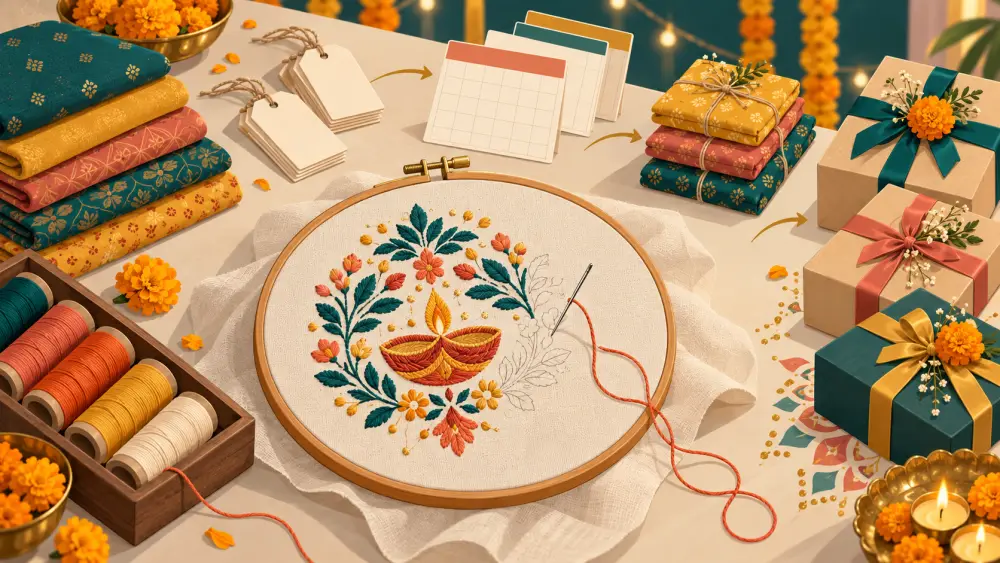
Embroidery is slow by nature. A single piece can take days, and festive gifting and personalised orders arrive in clumps with a date attached. If you accept every order that comes, you will either miss deadlines or stitch through the night and deliver rushed work. A plan helps you say yes to the right orders and no, politely, to the rest.
If you want the bigger calendar view first, read festive season selling: a calendar for small brands.
Step 1: Measure how long a piece actually takes
Time the real stitching of each design you sell: small hoop, medium frame, a name piece, a festive wear patch. Add finishing: washing, pressing, mounting in a hoop or frame, packing. Keep the numbers in a notebook. Do not estimate from memory; most makers underestimate.
Then count how many hours you can truly stitch per week. Divide to see how many pieces you can make before a given date. That is your capacity, and your order limit.
Step 2: Decide your product types
Personalised gifts need the most time, since you cannot stitch ahead. Ready designs can be made in advance. Festive wear work, such as embroidered borders, patches or blouse details, depends on the garment and fabric the customer provides, and this adds coordination time.
A sensible approach is to prepare ready designs early and keep a limited number of personalised slots. Say how many you will accept.
Step 3: Find your deadlines
Festival dates change every year, and school and office calendars differ, so check a current calendar instead of assuming. Work backwards: occasion date, minus courier time, minus packing, minus finishing, minus stitching, minus approval time for the design. The result is your last order date.
Step 4: Set approval rules for custom work
For names, dates or custom colours, ask for all details at once and share a sketch or text preview. Get a clear written yes. Tell the buyer that the clock starts after approval, not after payment alone. This prevents delays caused by changing details late.
Step 5: Stock fabric, thread and frames early
Run out of a thread shade and your piece waits. Check hoops, frames, backing fabric and packaging too. Order slow items early. If you rely on a supplier for custom frames or garments, ask for their dates before you commit to yours.
Step 6: Set clear dates on your listings
Put your order-by date on the product page and tell buyers what happens after it: perhaps you will still accept orders, but delivery will be after the occasion. Do not promise a delivery date you cannot control; couriers vary. See shipping across India: what small brands should know.
Step 7: Use stock numbers honestly
In your Varchas catalogue, set stock to what you can make, not to a hopeful guess. If you offer personalised slots, keep that number small and update it as orders arrive. When it reaches zero, the product shows as unavailable instead of taking orders you cannot meet. For multiple designs or colours, tracking stock per variant keeps the count accurate.
Step 8: Protect your health and your quality
Stitching late into the night leads to mistakes. It is better to close orders early than to deliver uneven work. If needed, bring in a helper for finishing and packing so you can spend your hours on stitching alone.
Checklist
- Hours per piece measured
- Weekly stitching hours counted
- Personalised slots limited
- Last order date calculated from the occasion
- Materials ordered early
- Dates and cut-offs on every listing
- Stock numbers set honestly
Gifting buyers prize reliability. A seller who says "last order date" and keeps it earns a repeat customer.